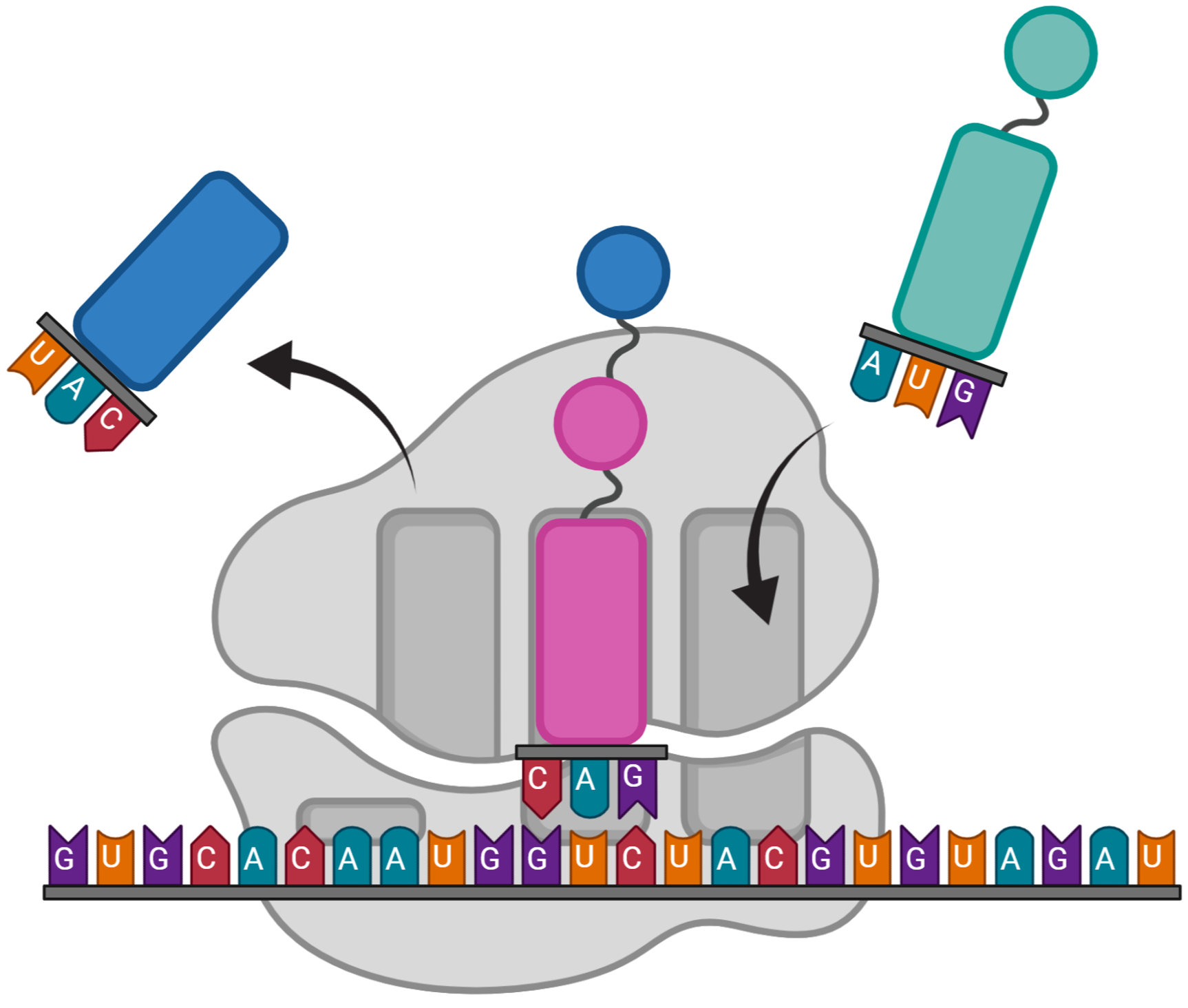
Chapter 11: From DNA to Protein
Overview
Central Dogma of Life
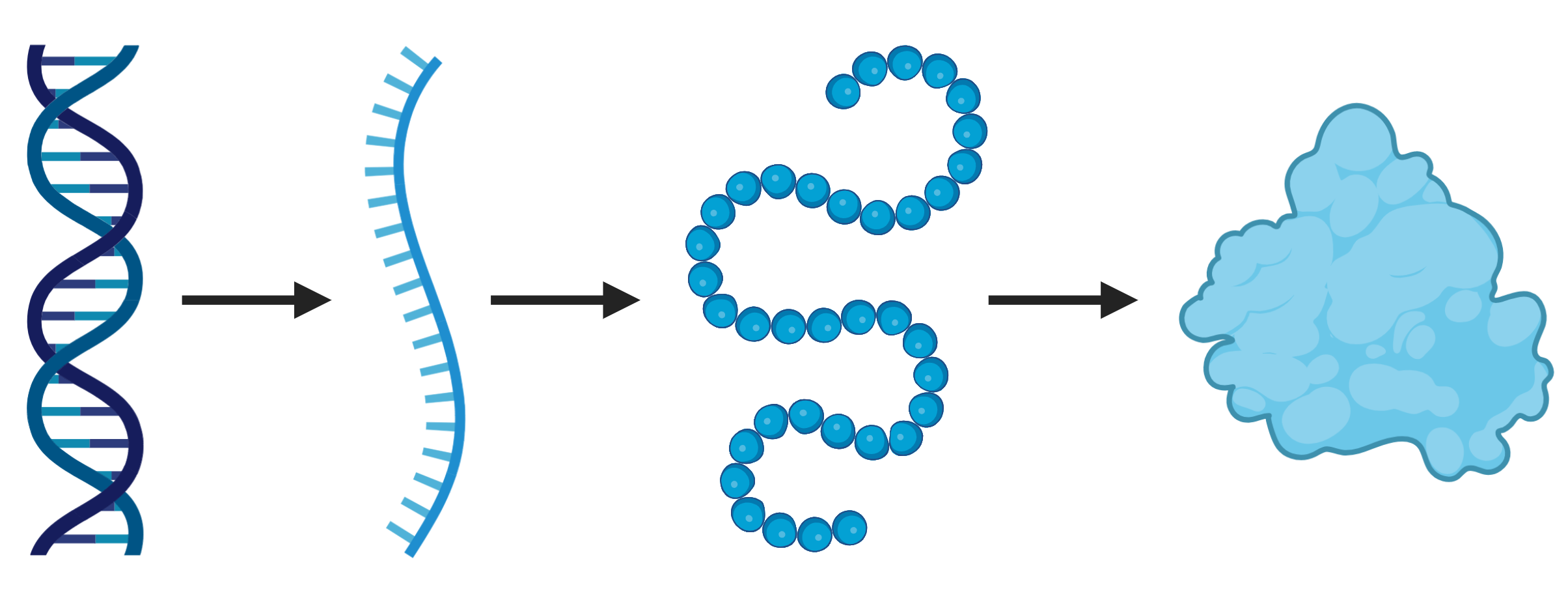
The central dogma of life describes the sequence by which genetic instructions in the DNA is ultimately carried out by the cell:
\[DNA \to mRNA \to Protein\]- Genetic information is stored in the DNA
- Genetic information in the DNA is transcribed to mRNA - “Transcription”
- Genetic information in mRNA is translated into proteins - “Translation”
- Proteins perform cellular functions
RNA
RNA
RNA:
- RNA is a nucleic acid
- Nucleic acids are polymers, made of nucleosome monomers
- RNA is made from four types of nucleosomes:
A(Adenine)C(Cytosine)G(Guanine)U(Uracil)- DNA is made of
A,C,GandT(Thymine)
- DNA is made of
- RNA is made from four types of nucleosomes:
- Unlike DNA, which is double stranded, RNA is single stranded
- RNA is synthesized in the nucleus by RNA polymerase
Types of RNA
There are three types of RNA:
- mRNA:
- Messenger RNA
- Carries the genetic information from the DNA to ribosomes
- tRNA:
- Transfer RNA
- Brings amino acids to the ribosome for protein synthesis
- rRNA:
- Ribosomal RNA
- Make up ribosome, along with proteins
- Synthesized in the nucleolus
Transcription
Transcription, mRNA Synthesis
Transcription:
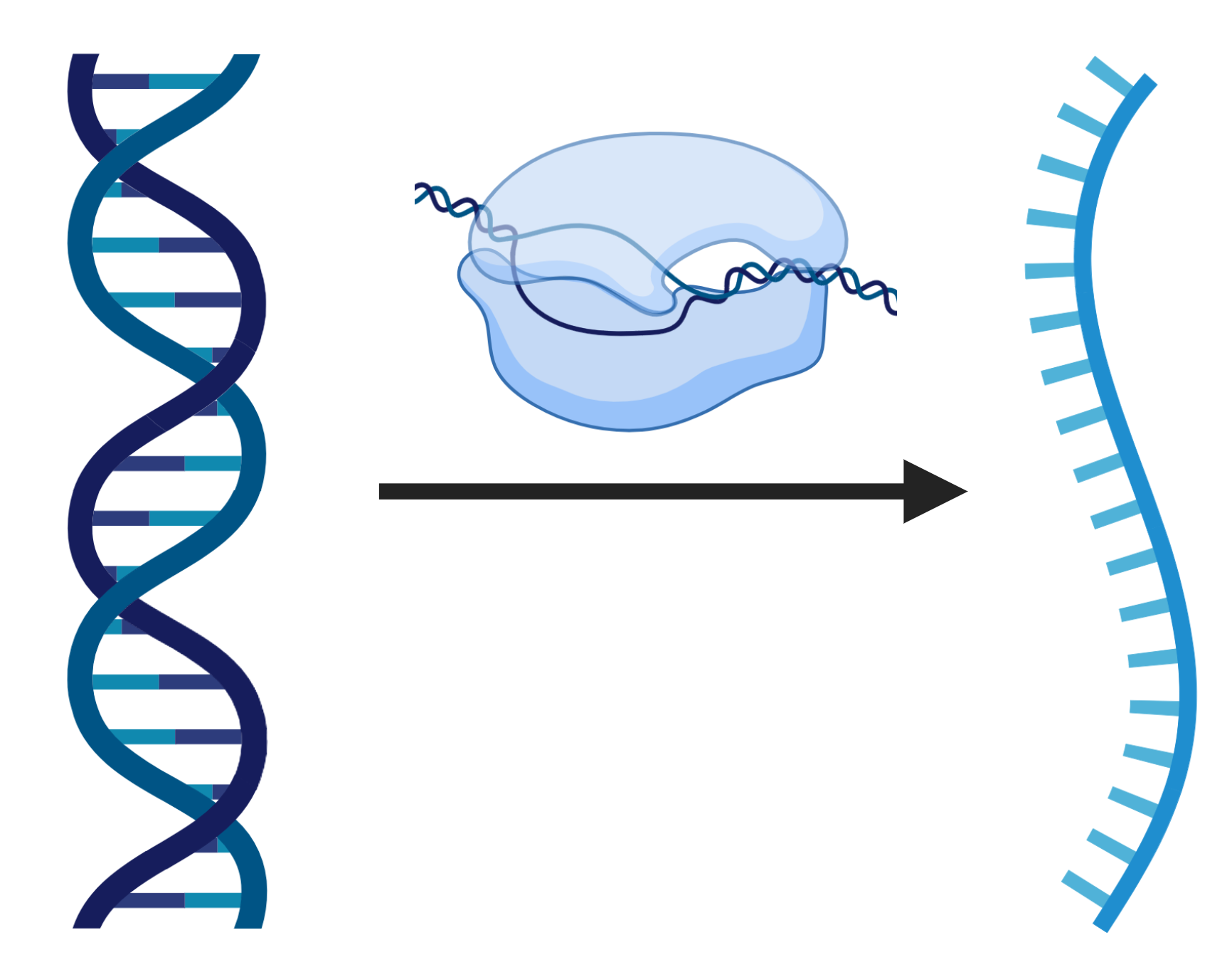
- mRNA is synthesized by RNA polymerase.
- The RNA polymerase unwinds the DNA and synthesizes RNA from nucleic acids that base-pair with the DNA, transcribing the DNA sequence to the RNA
mRNA Modification
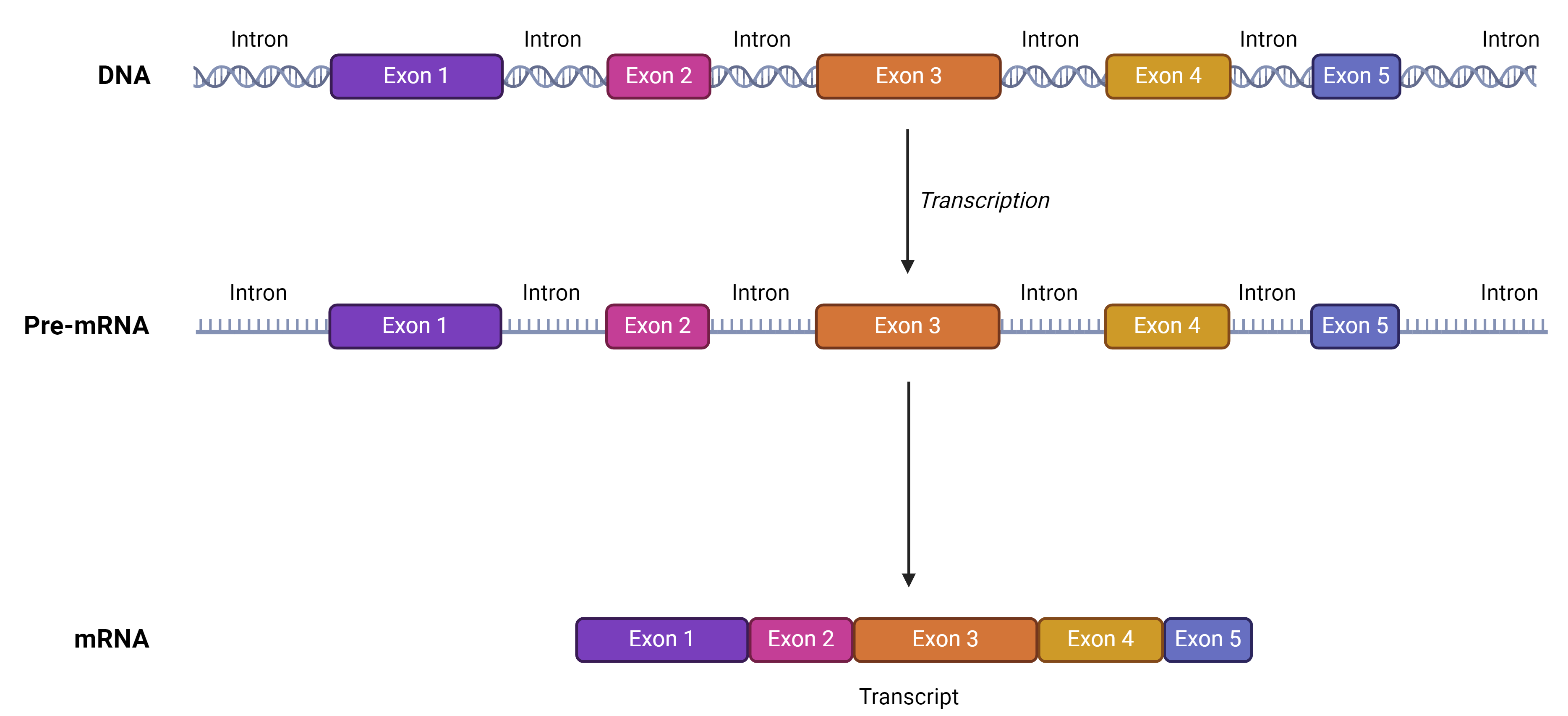
mRNA undergoes modification before it leaves the nucleus for the ribosomes.
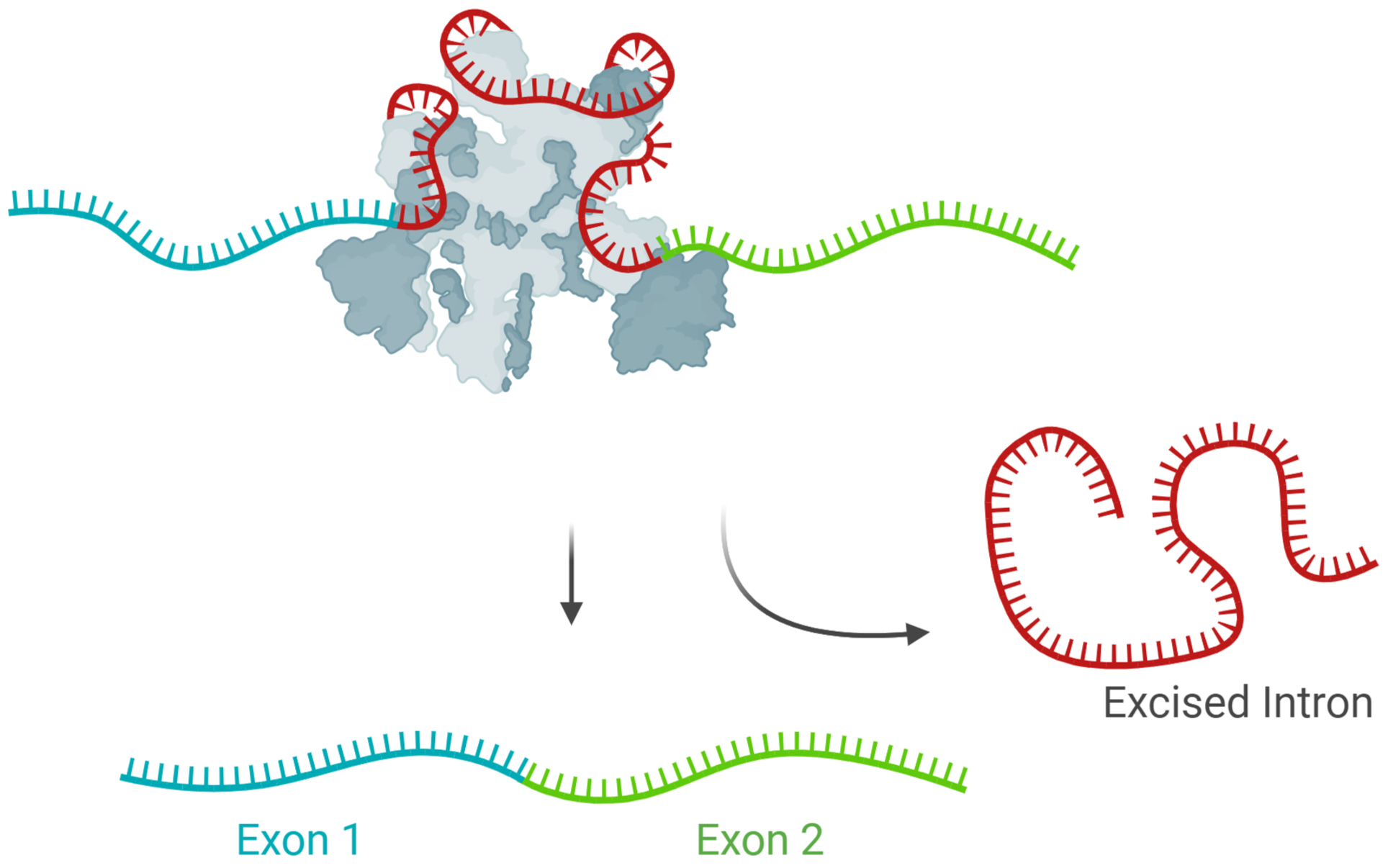
- One such modification is mRNA splicing.
- DNA contains introns - segments - which do not code for protein and are not part of the gene expression.
- When the mRNA is initially synthesized, the introns are included.
- During mRNA splicing, the introns are removed, and the remaining exons - coding portions - are reattached together.
Translation
Protein, Ribosomes
Protein:
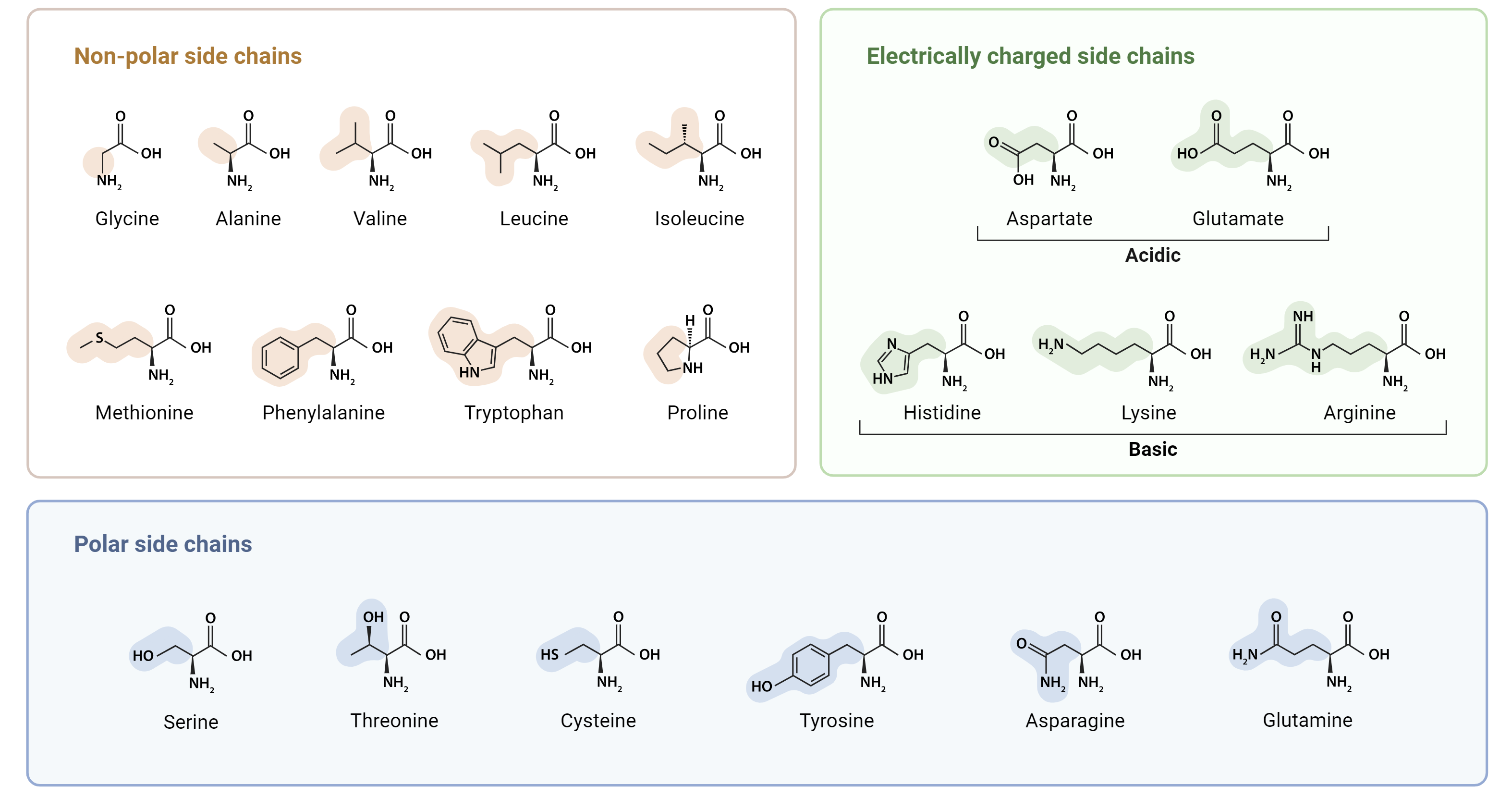
- Proteins are polymers made of amino acid monomers.
- There are 20 types of amino acids. The specific sequence of amino acids is what gives each protein its unique identity and properties.
- Protein synthesis takes place in ribosomes, which are in the cytoplasm.
Ribosomes:
- Ribosomes are made of rRNA and protein.
- Ribosomes are initially assembled in the nucleus.
- Ribosomes have two parts - the large subunit and the small subunit.
Codons, tRNA, Translation
Codons:
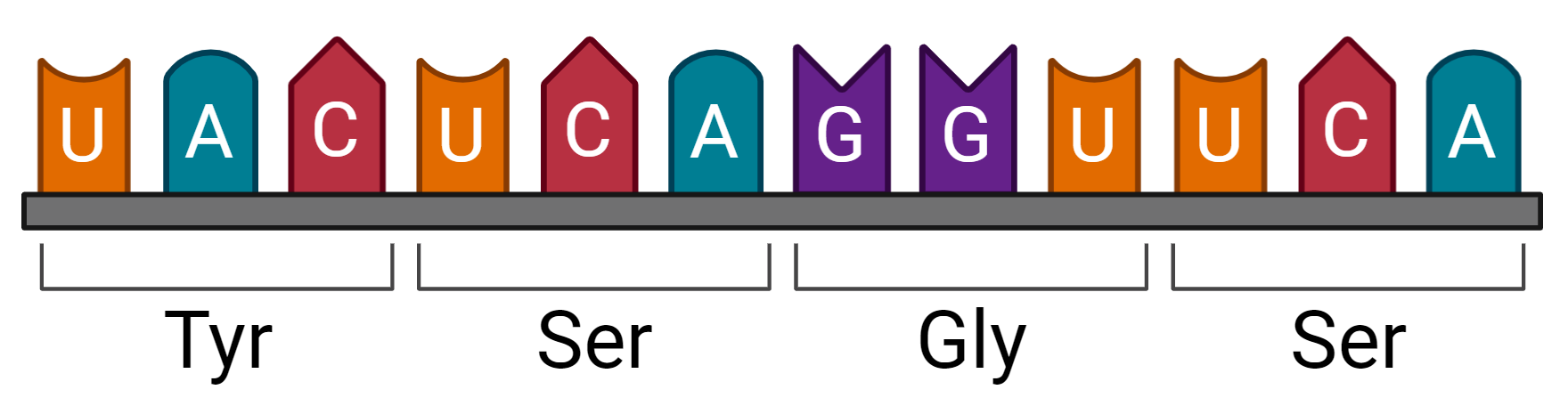
- Codons are sets of three nucleic acid bases.
- Each codon specifies a specific amino acid.
- The amino acid which is specified in the mRNA codon is added to the polypeptide chain, translating the mRNA information into protein.
tRNA:
- tRNA is used to bring amino acids to the ribosomes, and to translate the mRNA codon to its respective amino acid.
- tRNAs have an anticodon, which base pairs with the mRNA, and a specific amino acid for each anticodon.
- The mRNA codon will only pair with the corresponding tRNA, which in turn adds its amino acid to the polypeptide chain.
Example:
GCAcodes for Alanine:- To result in an alanine amino acid, the DNA codon will be
CGT. - The corresponding mRNA is
GCA. - The tRNA with the anticodon
CGUcarries alanine.
- To result in an alanine amino acid, the DNA codon will be
Codons
- As there are 64 possible codons ($4 \times 4 \times 4$) and only 20 amino acids, numerous codons code for similar amino acids.
AUGis the start codon; mRNA strands start withAUG. It translates to Methionine.- Several codons are the stop codons. They do not translate to an amino acid.
Prokaryotes vs Eukaryotes
There are several differences between prokaryotic and eukaryotic transcription and translation:
- Eukaryotes:
- The DNA is in the nucleus. Transcription takes place in the nucleus; translation takes place afterwards in the cytoplasm.
- mRNA undergoes modification
- Each mRNA only codes for one protein
- Prokaryotes:
- There is no nucleus; transcription and translation take place in the cytoplasm, simultaneously.
- mRNA is not modified.
- One mRNA can code for multiple proteins.
Schematics
Central Dogma of Life
- Overview
-
DNA → RNA → Polypeptide chain → Folded protein
-
-
Detailed
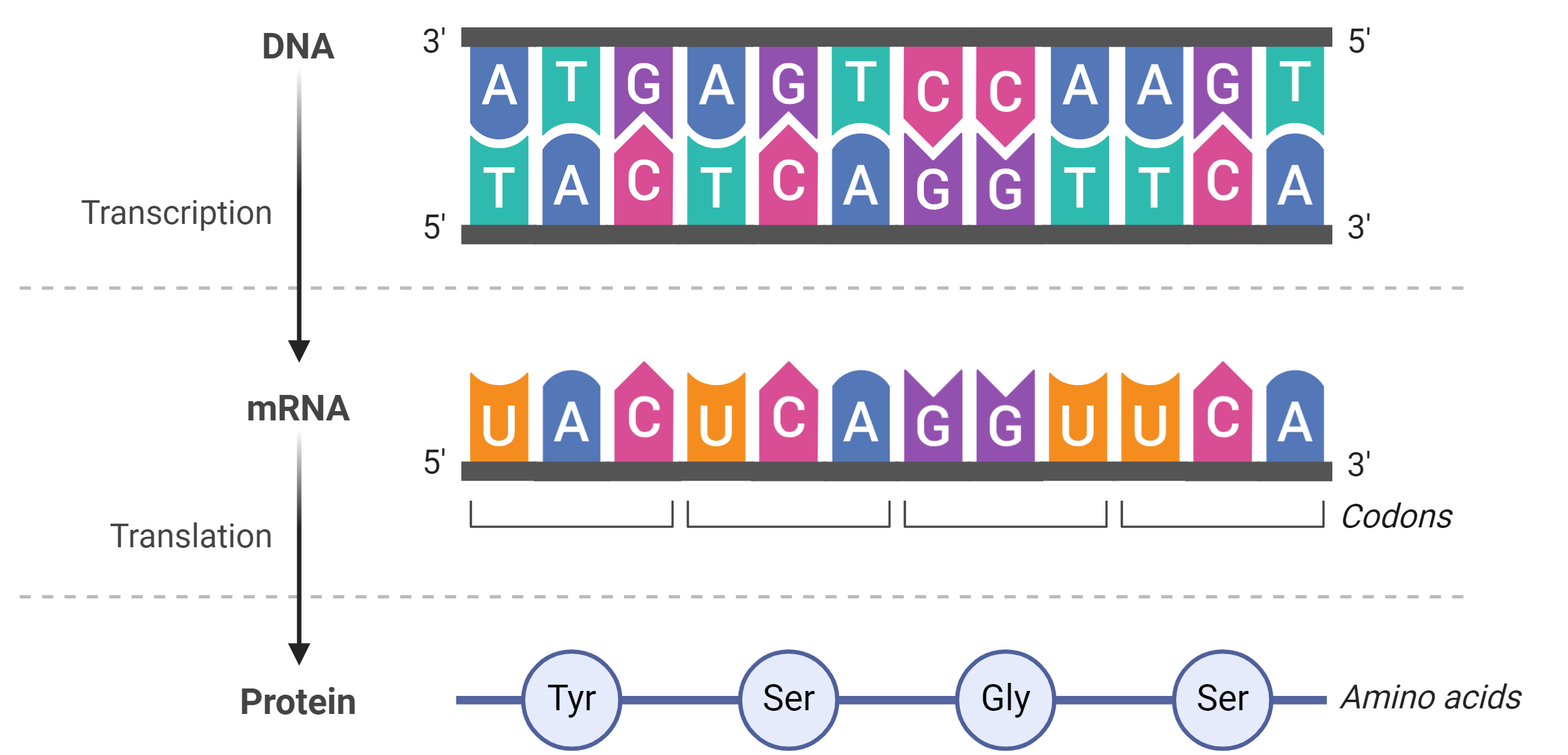
Transcription
- Transcription
-
RNA Polymerase unwinds DNA and synthesizes mRNA:
-
Splicing
-
Overview
-
pre-mRNA

-
mRNA splicing
Translation
-
Amino acids
-
mRNA codons
-
Codon table
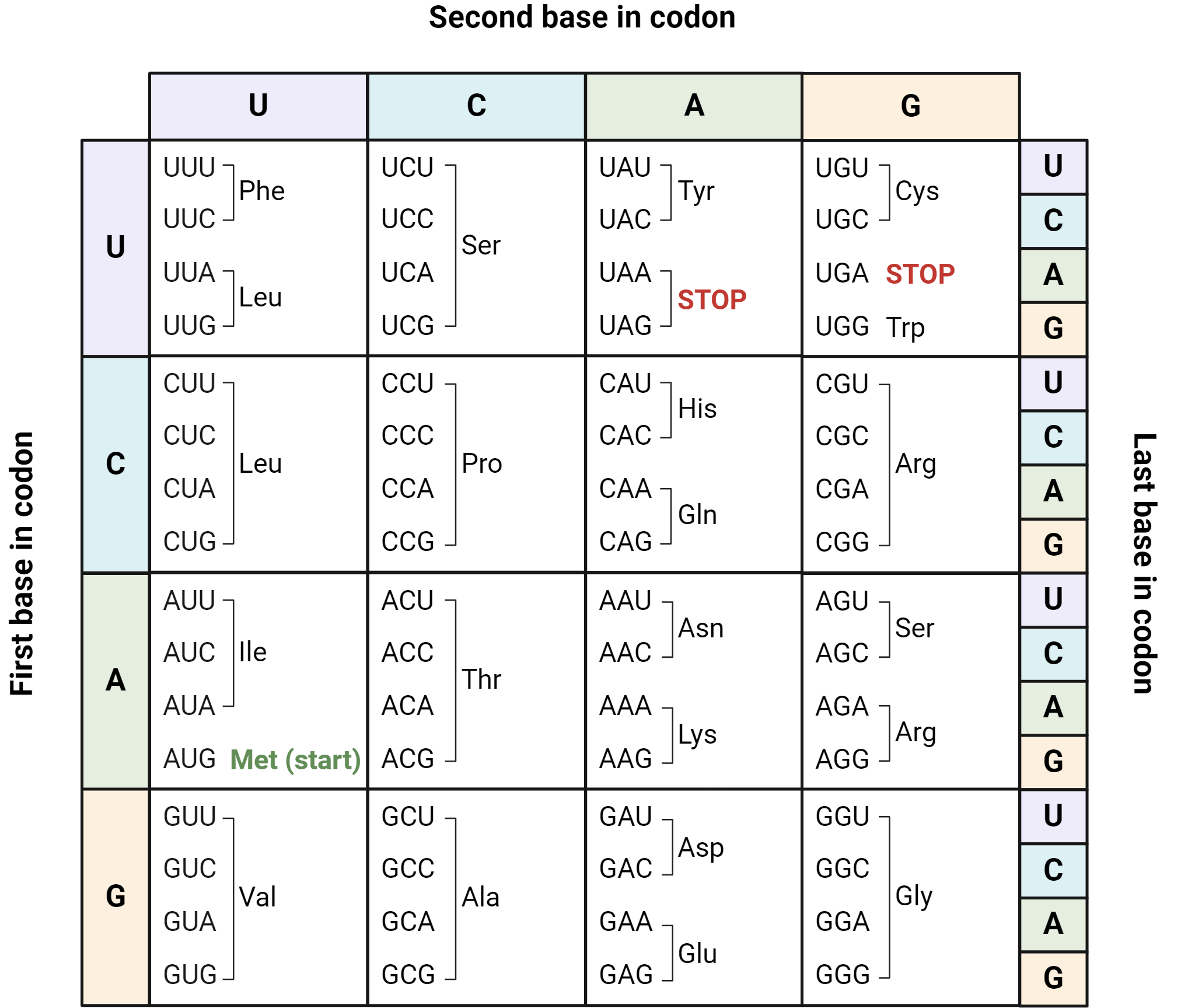
-
Codon wheel
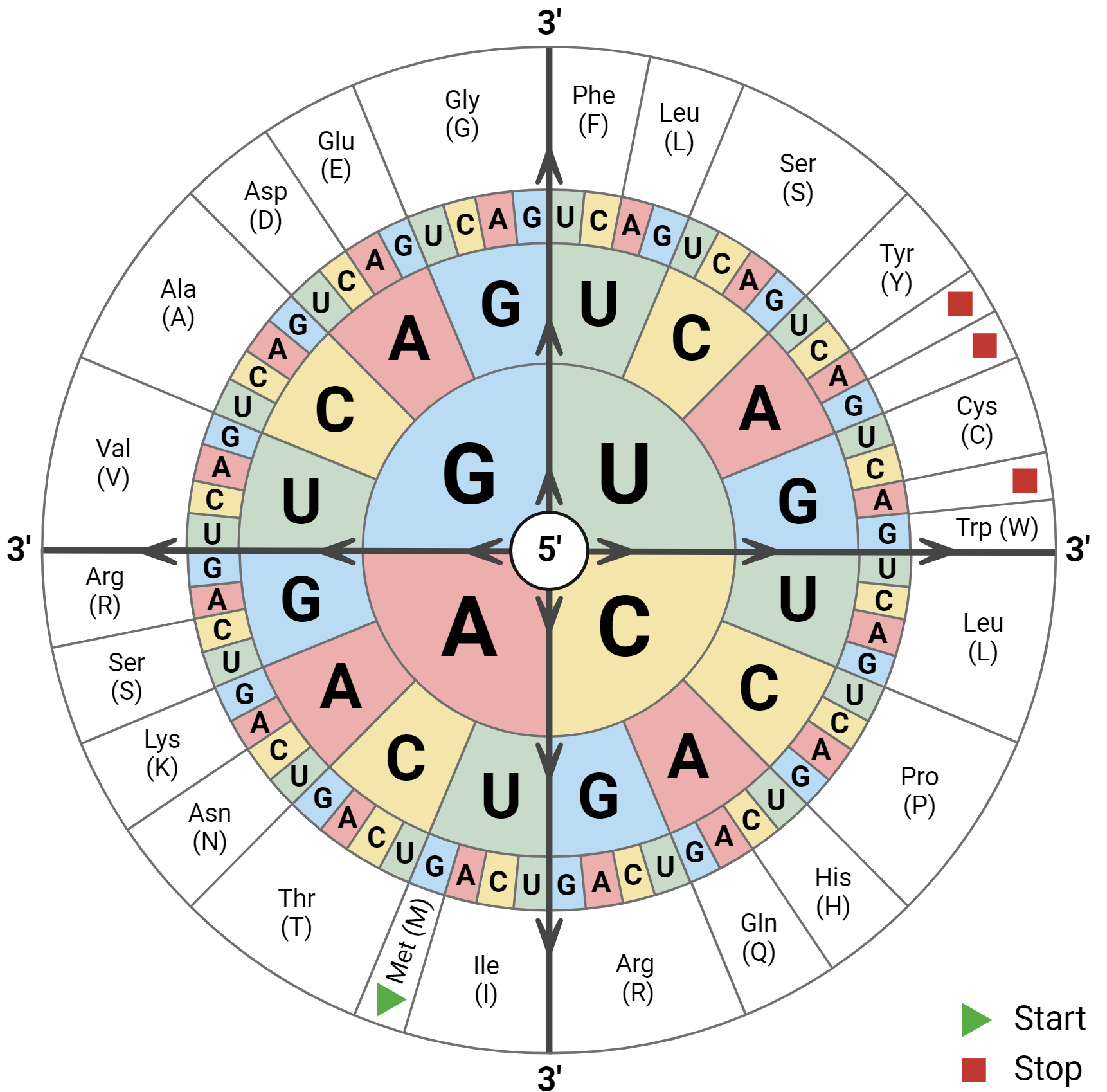
- Translation; overview
-
mRNA is translated by the ribosome to polypeptide chains:
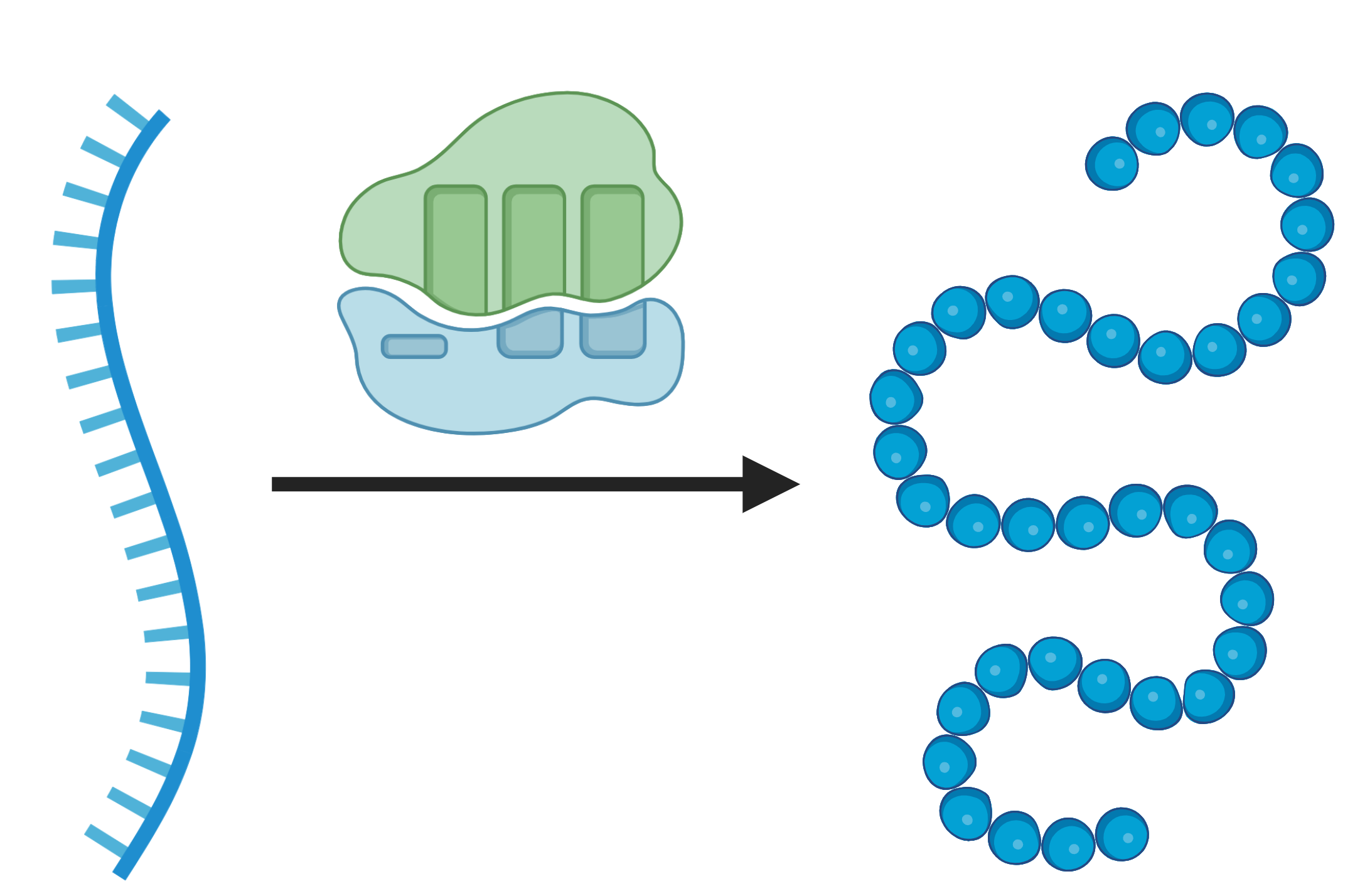
-
-
tRNA

-
Translation; detailed