Chapter 13: Ecology, Communities and the Environment
Ecology
Ecology
Ecology:
- Study of the interactions between organisms and their environment
Levels of Ecology
Level of ecology:
- Organism:
- Individual living entity
- Population:
- All the organisms of a species within an area
- Community:
- All the distinct populations within an area
- Ecosystem:
- System of communities and the abiotic systems with which they interact
- Biosphere:
- All the ecosystems on earth
Habitat, Niche
Habitat
Habitat:
- Area where an organism lives
Niche
Niche:
- An organism’s “place” within its environment
- Includes all the ways the organism interacts with its environment - where it lives, what it eats, its role within its ecosystem, etc.
Competitive exclusion principle:
- Two species cannot occupy the same niche; one will inevitably outcompete the other
Niche Partitioning:
- Two species coexisting in a niche by partitioning the niche
- Example: Two species of birds occupying different parts of a tree
Interactions
Competition
Organisms in an ecosystem compete for resources - such as food, space, mates
Intraspecific Competition:
- Competition within a species
Interspecific Competition:
- Competition between two distinct species
Predation
Predators eat prey.
Symbiosis
Symbiotic Relationship:
- Extended interactive relationship between different species
- Mutualism:
- Both organisms benefit
- Example: sea anemone and clown fish
- Both organisms benefit
- Commensalism:
- One organism benefits and the other is unaffected
- Example: whale and barnacle
- One organism benefits and the other is unaffected
- Parasitism:
- One organism benefits and the other is harmed
- Example: dog and flea
- One organism benefits and the other is harmed
Food Chain
Organic Material
Organisms obtain energy by consuming organic material.
The organic material needs to be synthesized from inorganic material.
Trophic Categories
Autotroph:
- Organism that synthesizes its own organic material
- Photosynthesis:
- Process by which plants synthesize organic material using sunlight
- Chemosynthesis:
- Process by which select organisms synthesize organic material using energy obtained from oxidative reactions
Heterotroph (Consumer):
- Organism that obtains organic material by consuming other organisms
Types of Consumers
Consumer:
- Organism that obtains organic molecules by consuming other organisms
Types of consumers:
- Herbivore:
- Eats plants
- Carnivore:
- Eats animals
- Omnivore:
- Eats both plants and animals
- Detritivore:
- Eats dead organisms
- Decomposer:
- Secretes enzymes that decompose organic material back into inorganic material
- Includes bacteria, fungi
Food Chain
Food Chain:
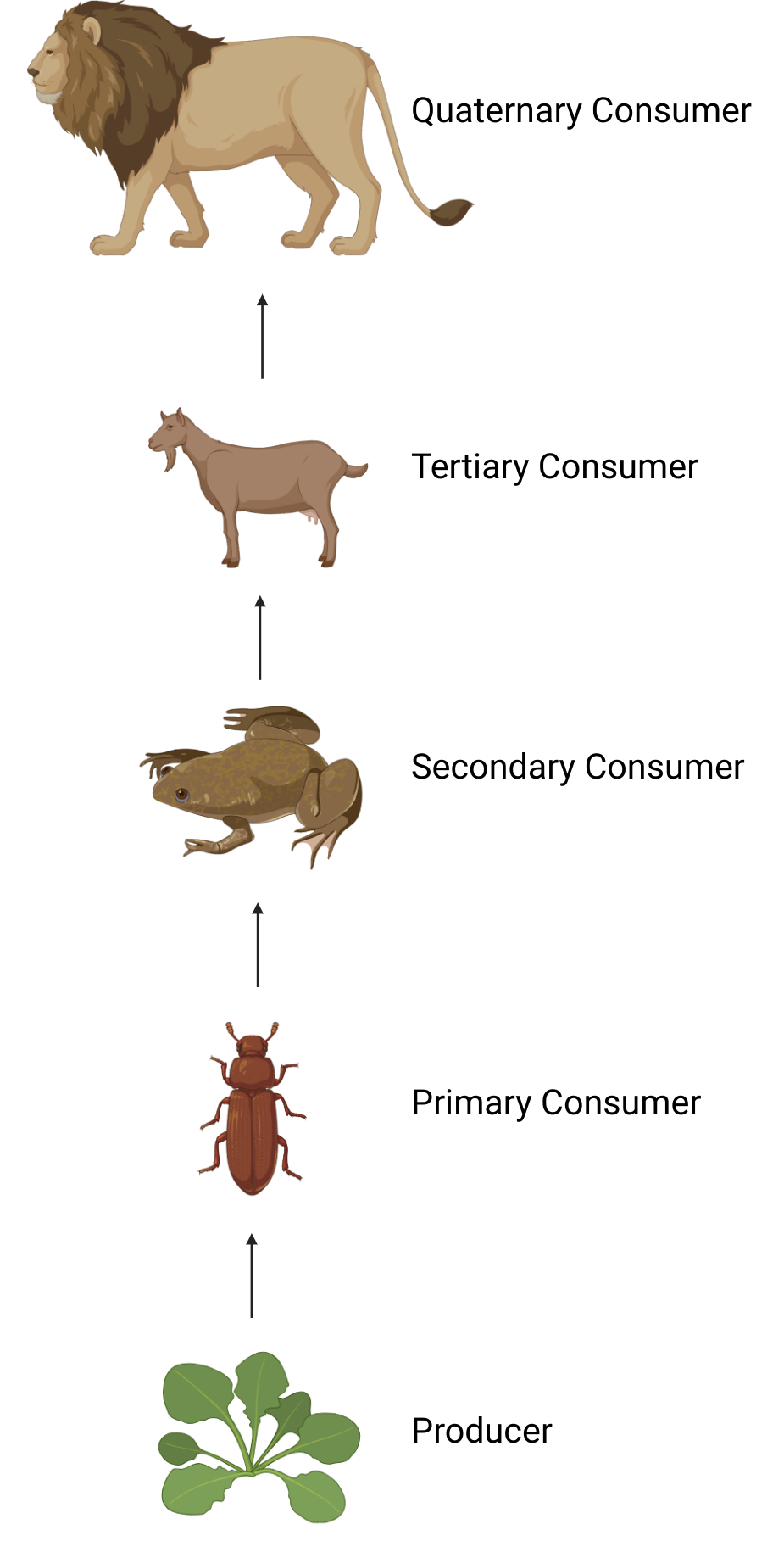
- Linear representation of the progression of food, from the organism that synthesizes it, up to the organism that eats it, etc.
Food Web:
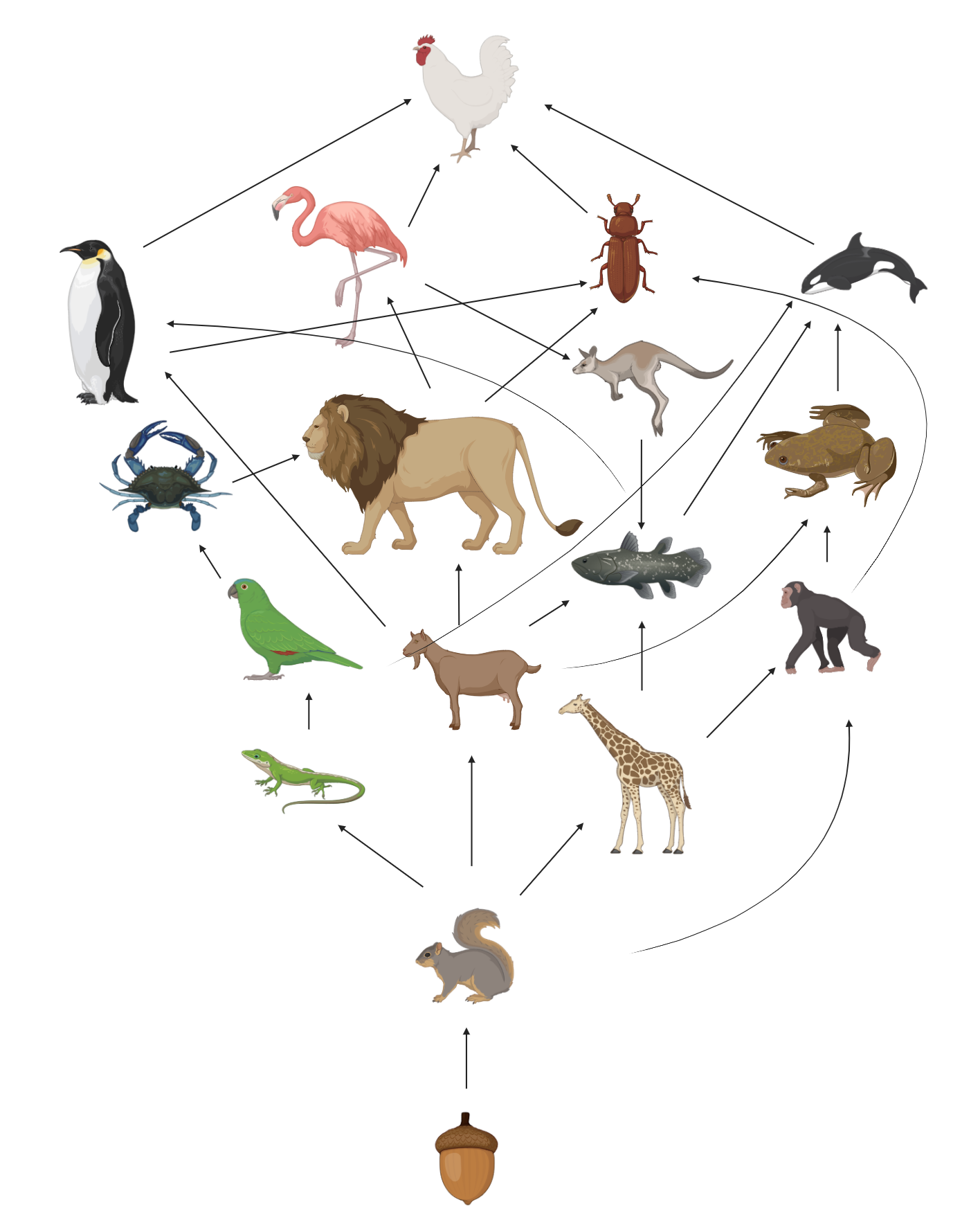
- Non-linear representation of the food progression; takes into account that organisms may eat others on their level, or others more than one level below, etc.
- More complex than a food chain; generally more realistic
Trophic Level:
- An organism’s level within a food chain
- Producer:
- Bottommost, autotroph
- Primary Consumer ($1 ^\circ$):
- Eats the producer
- Secondary Consumer ($2 ^\circ$):
- Eats the primary consumer
- Tertiary Consumer ($3 ^\circ$):
- Eats the secondary consumer
- Quaternary Consumer ($4 ^\circ$):
- Eats the tertiary consumer
- Producer:
- In a food web, an organism can have multiple trophic levels; for example, it can be both a primary and secondary consumer
Food Chain Pyramids
Food Chain Pyramid:
- Demonstrates a variables variation at each trophic level
- Food Chain Energy Pyramid:
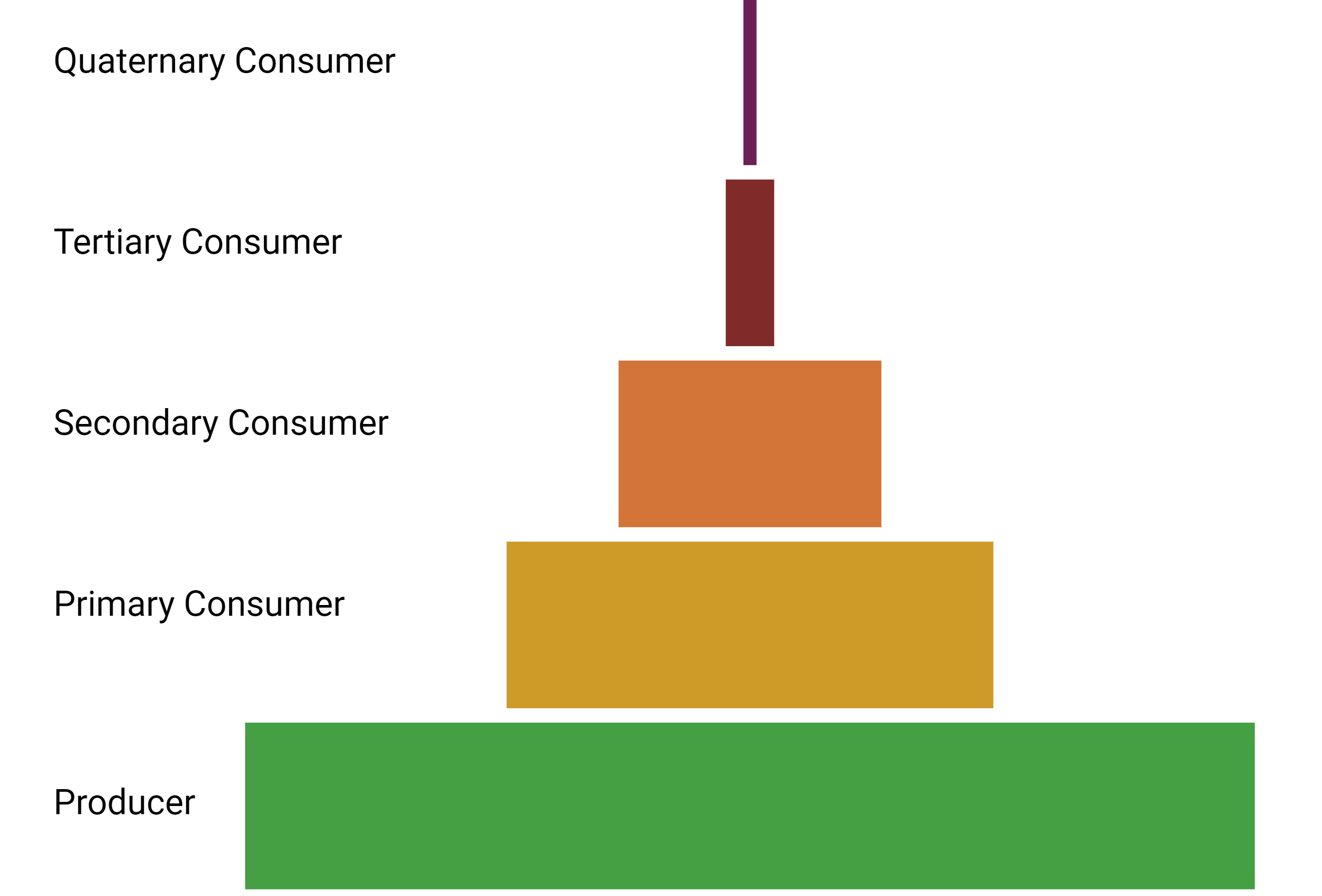
- The food chain’s energy pyramid is always largest at the bottom and smaller as it goes up
- Each trophic level has less energy than the previous level
- Each transformation of energy between levels loses energy to entropy
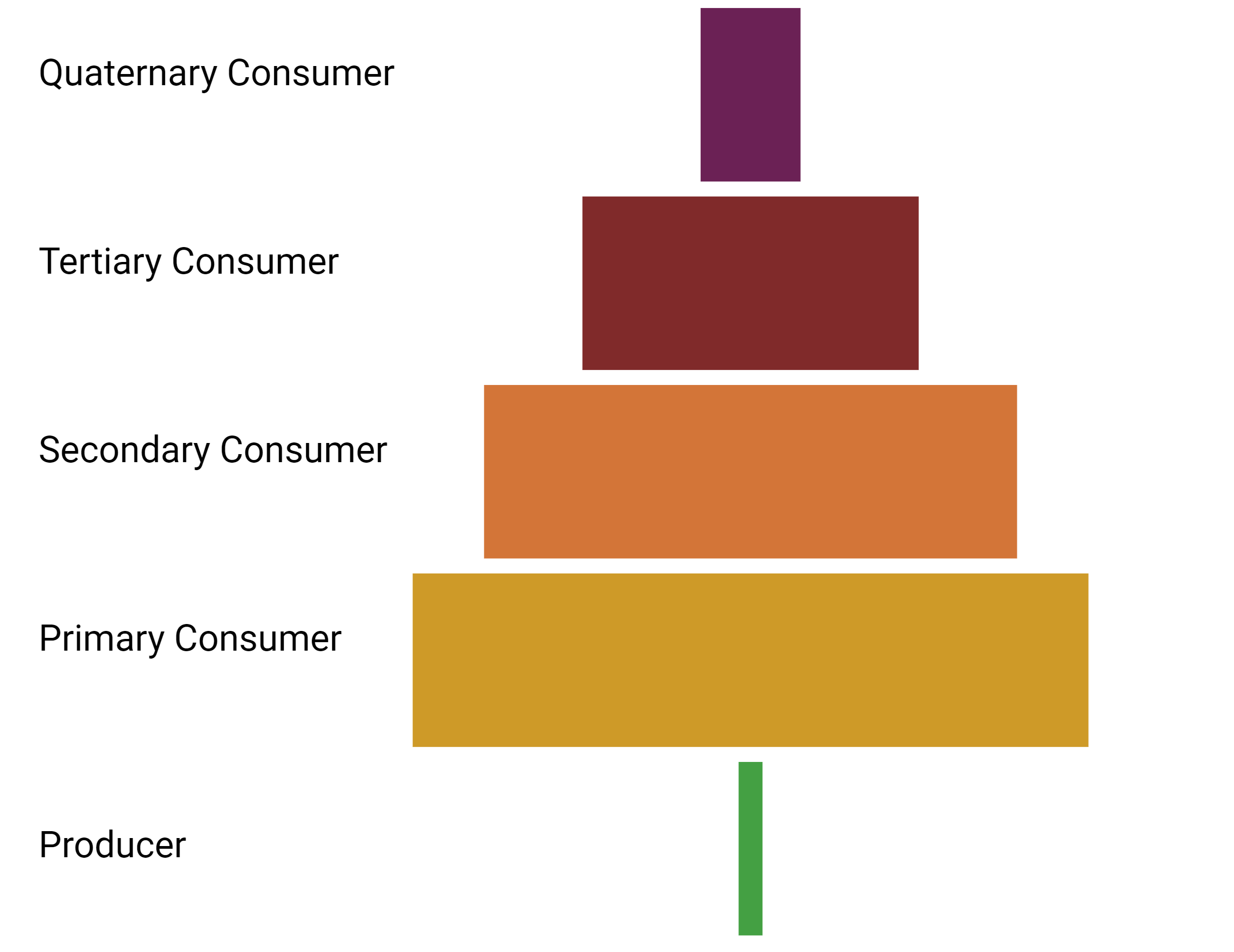
- Other food chain pyramids include pyramid of numbers - demonstrating the number of organisms at each level, and pyramid of biomass - demonstrating the total biomass at each level.
- The pyramid of biomass is typically largest on bottom and smaller as it goes up, however, the pyramid of numbers can assume varied shapes.
Abiotic Cycles
Abiotic Resources
Abiotic - non living - resources, such as water and nutrients, are finite.
Essential elements are cycled between biotic and abiotic states.
Water Cycle
In the water cycle, water cycles between the atmosphere and the geosphere:
- Precipitation:
- Water falls from clouds as rain or snow
- Evaporation:
- Open water evaporates into the atmosphere
- Transpiration:
- Water in leaves evaporates into the atmosphere
- Condensation:
- Water in the atmosphere condenses into clouds
Carbon Cycle
- Atmospheric $CO_2$ is absorbed by plants during photosynthesis
- $CO_2$ is released into the atmosphere by:
- Decomposition
- Respiration
- Burning fossil fuels such as coal, oil and gasoline
Nitrogen Cycle
- Atmospheric nitrogen is not directly usable
- Nitrogen Fixation:
- Various bacteria convert atmospheric nitrogen to a usable form
- Assimilation:
- Plants absorb nitrate from the soil
- Other organisms obtain nitrogen by eating plants, etc.
- Decomposition:
- Biotic organisms die, decompose, and the nitrogen is returned to the soil
- Decomposed nitrogen can be recycled, or denitrified by bacteria and returned to the atmosphere.
Phosphorous Cycle
- Phosphorous is needed for ATP, DNA, RNA, phospholipids, bones, and other organs.
- The phosphorous cycle does not have a gaseous phase, and takes much longer than other cycles.
Schematics
-
Food chain
-
Food web
-
Energy Level Pyramid
-
Pyramid of Numbers