Chapter 6: Energy and Enzymes
Thermodynamics
Energy
Energy is the capacity to do work. Energy is classifed as:
-
Potential Energy: Energy stored in a system due to its location or configuration;
- Such as gravitational potential energy of an object at height;
-
Kinetic Energy: Energy of a moving object.
Thermodynamics: Study of the transfer of energy between systems
First Law of Thermodynamics (Conservation of Energy): Energy can change forms or be transferred between systems but cannot be created or destroyed.
Second Law of Thermodynamics: Evey transformation of energy involves some amount of energy dissipation as heat, lowering the amount of useful ordered energy and increasing entropy
Entropy: Measure of disorder
Chemical Reactions
In a chemical reaction, reactants are turned into products.
-
Anabolic Reaction: Smaller molecules bond to form larger molecules
-
Catabolic Reaction: Larger molecules decompose to smaller molecules
Reaction Pathway: There may be one or more transition states between the reactants and products. The sequence of reactants, transition states, and products is the reaction pathway.
Energy of Chemical Reactions
Endothermic reaction: Reaction where the products have more energy than the reactants.
- The chemical system absorbs energy from its surroundings.
Exothermic reaction: Reaction where the products have less energy than the reactants.
- The chemical system releases energy to its surroundings.
A reaction’s spontenaity depends on two factors:
-
$\Delta H$: The change in energy
- Systems tend to the configuration with the lowest energy; exothermic reactions are favored
-
$\Delta S$: The change in entropy
-
Entropy tends to increase
-
The affect of entropy change is scaled by temperature; at higher temperature, there is a stronger tend to greater entorpy
-
Gibbs Free Energy: Describes the total spontenaity of a reaction by combining the affects of the changes in energy and entropy:
\[\Delta G = \Delta H - T \Delta S\]-
where
-
$\Delta G$ is the total change in Gibbs free energy;
-
$\Delta H$ is the change in energy due to exchange with surroundings;
-
$T$ is temperature; and
-
$\Delta S$ is the change in entropy.
-
Exergonic Reaction: Reaction where $\Delta G$ is negative; occurs spontaneously
- Although the actual change from reactants to products does not require energy and occurs spontaneously, the reaction still requires activation energy to occur
Endergonic Reaction: Reaction where $\Delta G$ is positive; does not occur spontaneously
Coupled reaction: Exergonic reaction paired with endergonic reaction
- The exergonic reaction provides energy for the endergonic reaction
Cellular Chemical Reactions
Metabolism
Metabolism: The set of chemical reactions that occur within a cell
Energy circle of life:
- Complex molecules such as sugars have greater energy than their simple components.
- A reaction that forms a complex molecule from simpler components is endergonic and absorbs energy.
- A reaction that breaks down a complex molecule to its simpler components is exogonic and releases energy.
- Plants absorb energy from the sun and use this energy to build sugars, storing the energy as chemical potential energy in the sugar’s chemical bonds.
- Cells obtain this energy by breaking down the sugars.
- The released energy is stored in ATP, which the cell can readily use as a source of energy.
Metabolic pathway: The reaction pathway of a metabolic reaction
- Anabolic Pathway:
- Builds complex molecules from simpler ones
- Absorbs energy
- Catabolic Pathway:
- Breaks complex molecules to simpler ones
- Releases energy
Many chemical bonds in biological systems are formed through dehydration synthesis and broken through hydrolysis.
Catalysts, Enzymes
Catalyst
Activation energy: Energy required to initiate a chemical reaction
- To change from reactants to products, the reactants must first enter a transition state, which is less stable and has higher energy than both the reactants and products.
- The energy needed for the products to reach the transition state is the activation energy
- This is generally provided by the kinetic energy of the reactants
Catalyst: Substance that increases the rate of a reaction without being consumed
- A catalysts increases the rate of a reaction by lowering the amount of activation energy needed
- The catalysts lowers the amount of activation energy needed by stabilizing the transition state
Enzyme
Enzyme: Organic catalyst
- The enzyme is not consumed by the reaction, remains unchanged, and is reusable.
- Enzymes are a type of protein
- Nomenclature: Generally ends with
-ase- Example: “Urease” is an enzyme that catalyzes “urea”
Components:
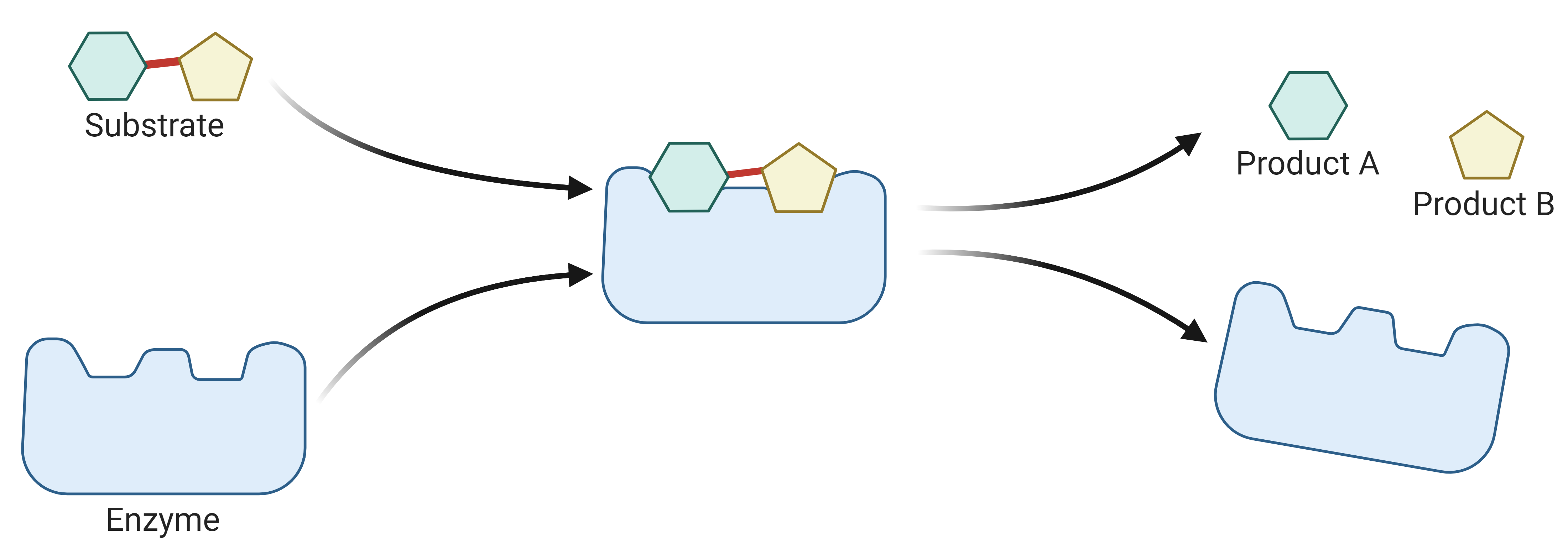
- The reactants bond to the enzyme, undergo the reaction, and the products are released
- Substrate: Term for the reactants that bond to the enzyme
- Enzyme-substrate complex (ES): Term for the entity formed by a substrate bonding to an enzyme
- Active site: The part of the enzyme the substrate bonds to
- Each enzyme is tailored for a specific chemical reaction; the active site is configured to match the substrate
- Induced-fit model: Current theory stating that the active site in an enzyme does not initially fit its substrate; rather, upon initial contact with the substrate, the enzyme conformes to fit it
Generic equation for enzymatic reaction:
\[E+S \rightarrow ES \rightarrow E+P\]where
- $E$ is the enzyme;
- $S$ is the substrate;
- $ES$ is the enzyme-substrate complex; and
- $P$ is the product.
Inhibitors
Inhibitor:
- Inhibitors are molecules that prevent an enzyme from catalyzing its reaction
- The cell uses inhibitors to control the formation of products
- Classes of inhibation:
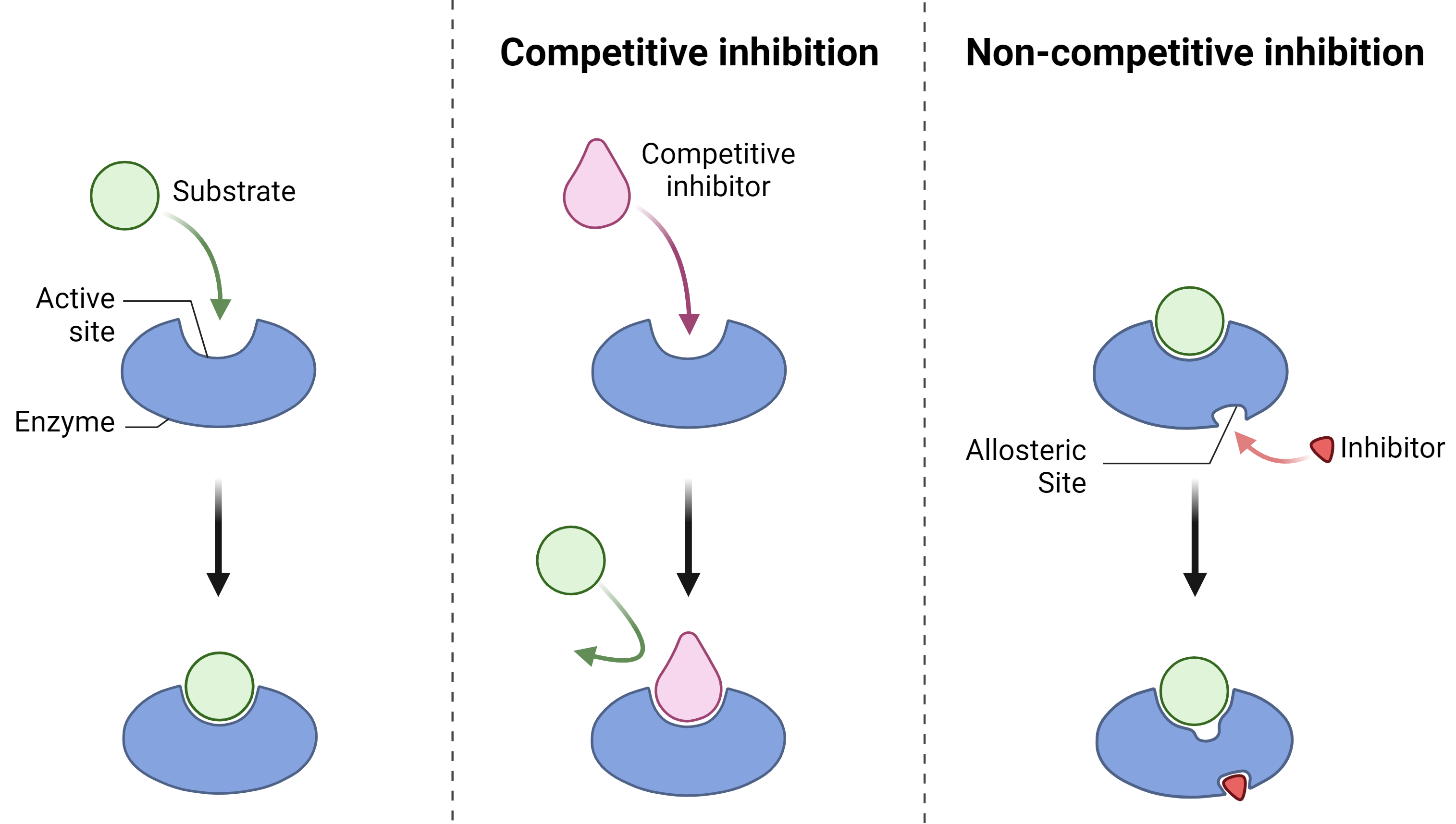
- Competitive inhibition: The inhibitor bonds to the enzyme’s active site, “competing” with the substrate and using up the active site
- Non-competitive inhibition: Instead of bonding to the active site, the inhibitor bonds to a different site, which causes the enzyme to change shape and no longer fit the substrate
Allosteric Site:
- Part of an enzyme where allosteric effectors bond
- Allosteric effectors are not substrate; instead, they regulate the enzyme by bonding to it and changing its shape
- Allosteric effectors can enhance the enzyme or inhibit it, as is non-competitive inhibition
Feedback Inhibition:
- Self-regulaotry mechanism within some metabolic pathways
- A downstream step in the pathway forms an inhibitor that inhibits an upstream step, preventing the pathway from repeating
Factors that Affect Enzyme Function
- Enzymes have specific optimal operational conditions.
- Under non-optimal conditions, enzymatic activity decreases.
- Certain conditions can cause denaturation, where an enzyme loses its shape and ceases to function
Factors:
- Temperature: Enzyme effectiveness increases with increases temperature; however, excessive temperature can cause denaturation
- Concentration: Increased enzyme concentration increases reaction rate
- pH:
- Each enzyme has an optimal range of pH
- Most are between 6 and 8
- pH out of the optimal range decreases enzyme function and can cause denaturation
- Presence of cofactors, coenzymes, or other enzyme modulators such as inhibitors
- Cofactors, Coenzymes:
- Increase an enzyme’s activity
-
Coenzymes are organic molecules; cofactors are inorganic molecules
- Cofactors, Coenzymes:
Schematics
-
Enzyme
-
Enzyme inhibition