Chapter 7: Photosynthesis and Cellular Respiration
Overview
Life Chemical Energy
Life requires energy.
Energy is often stored in chemical bonds: energy is used to create a chemical bond and is then stored in the bond. To release the energy, the bond is broken.
Metabolism: The totality of all chemical reactions in an organism
Energy is often transferred through the transfer of high-energy electrons
Redox reaction: Reaction in which one molecule gains an electron and one loses
- Oxidation reaction: Reaction in which a molecule loses an electron
- Reduction reaction: Reaction in which a molecule gains an electron
Circle of Life Energy
Life on earth obtains energy from the sun.
Photosynthesis: Cells use energy from the sun to create glucose, storing the energy in the glucose
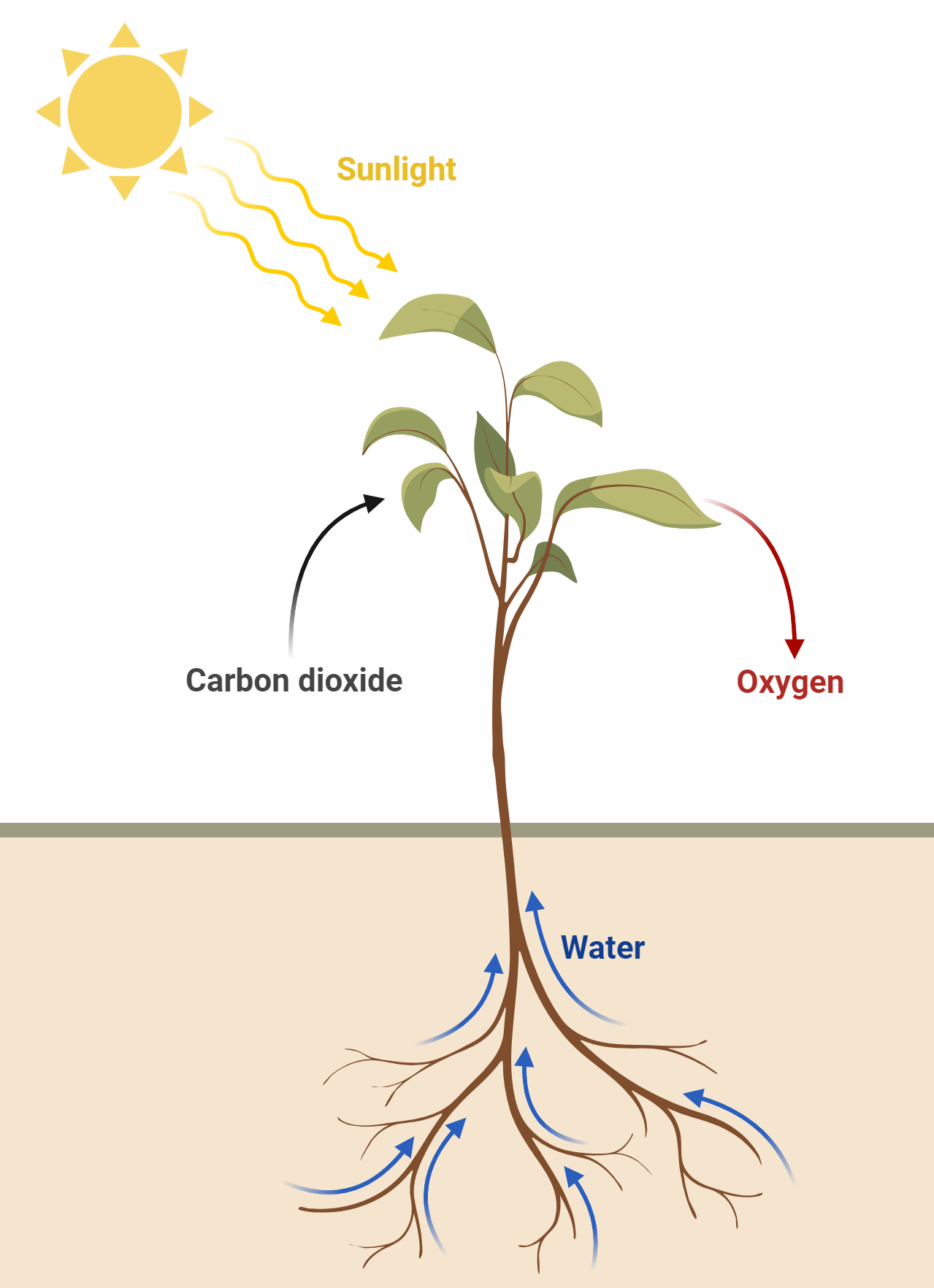
- Overview: Takes $H_2O$ and $CO_2$; creates $C_6H_{12}O_6$ (glucose), releases $O_2$
- Process:
- $H_2O$ is split
- The oxygen from the $H_2O$ is released as a byproduct
- Energy from the sun fuses the hydrogen with $CO_2$, making glucose
Cellular Respiration: Cells breaks down glucose and uses the released energy to make ATP, which is used as the cellular “energy currency”
- Overview: Takes $C_6H{12}O_6$ (glucose) and $O_2$; creates ATP, releases $CO_2$ and $H_2O$
- Process:
- The hydrogen is broken from the $C_6H_{12}O_6$
- The carbon and oxygen are released as a $CO_2$ byproduct
- The energy released by breaking the hydrogen from the glucose is used to make ATP
- The hydrogen is then removed with oxygen as $H_2O$
ATP
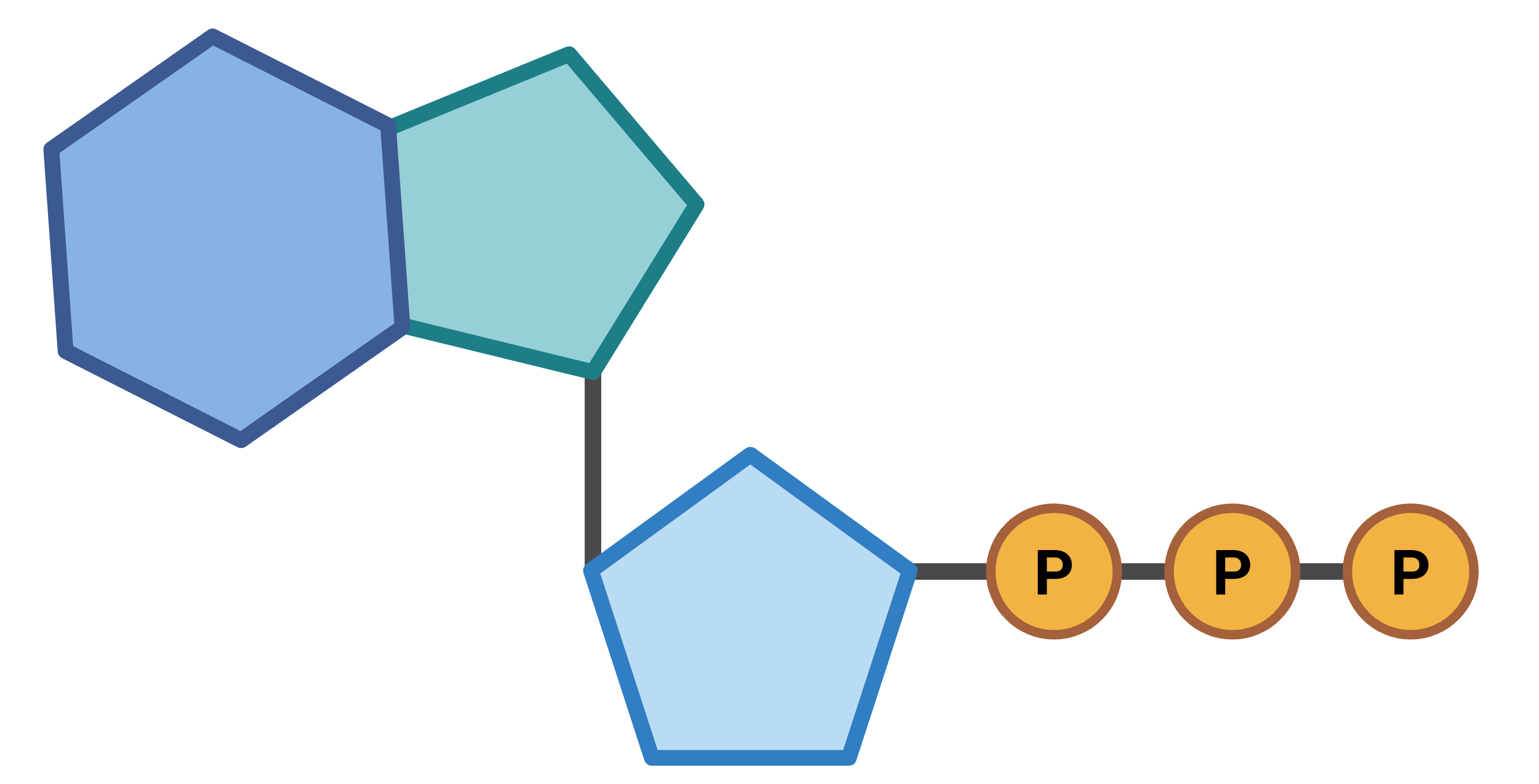
ATP (Adenosine triphosphate): Contains three phosphate groups
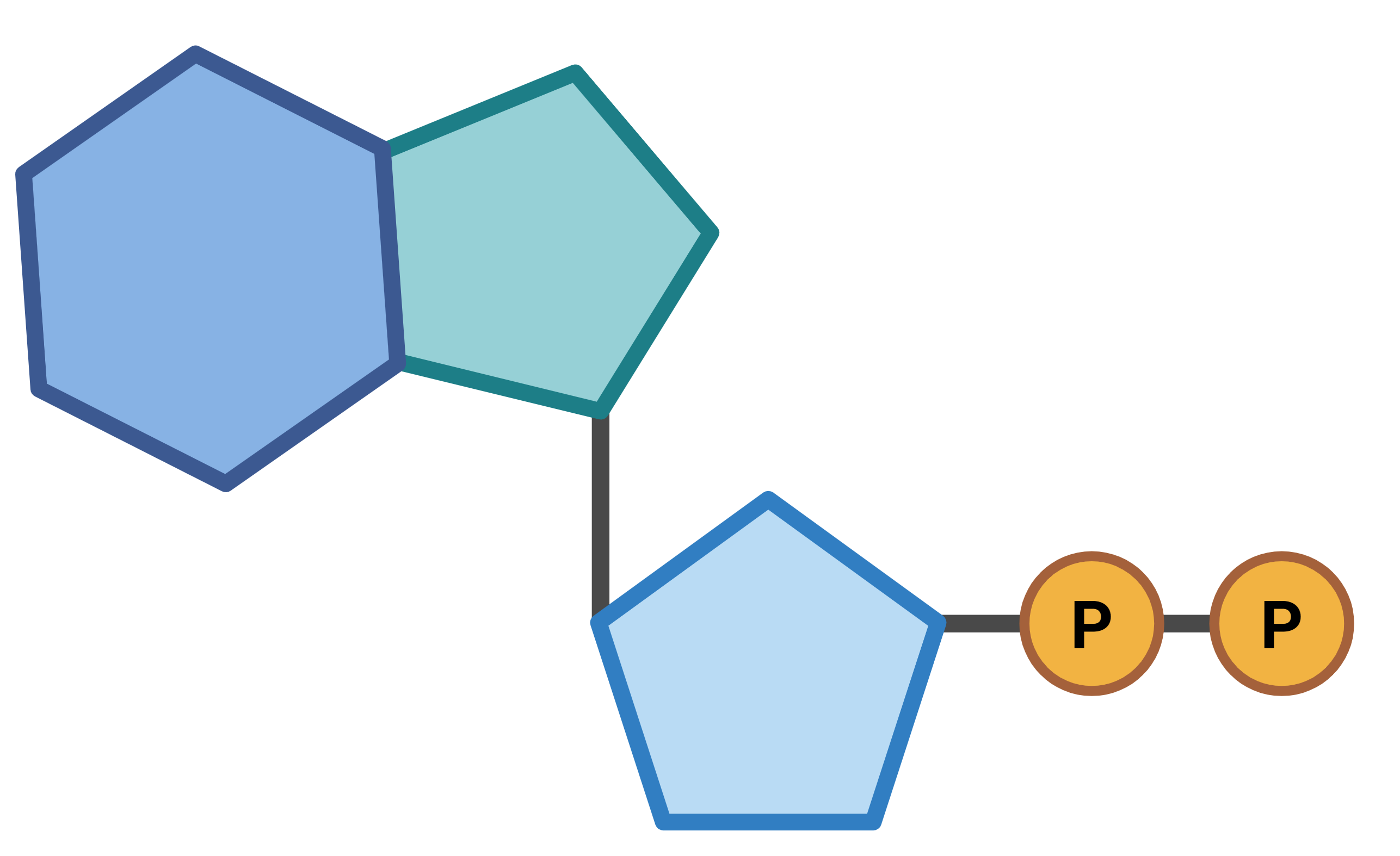
ADP (Adenosine diphosphate): Contains two phosphate groups
ATP energy:
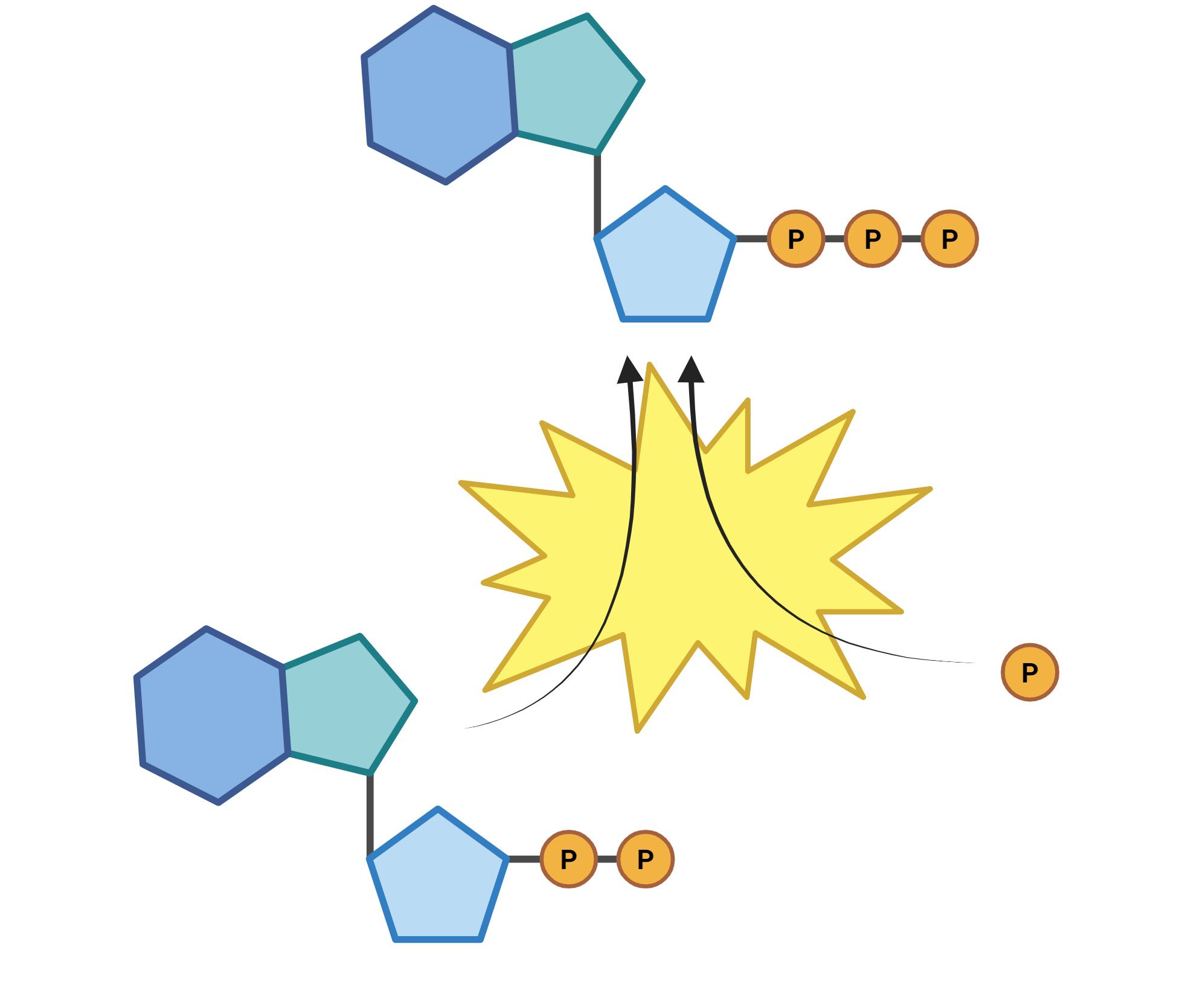
- Cells “charge” ATP by using energy to fuse a third phosphate group to ADP, turning it into ATP and storing the energy in the bond with the added phosphate group
- Phosphorylation: Adding a phosphate group to a molecule
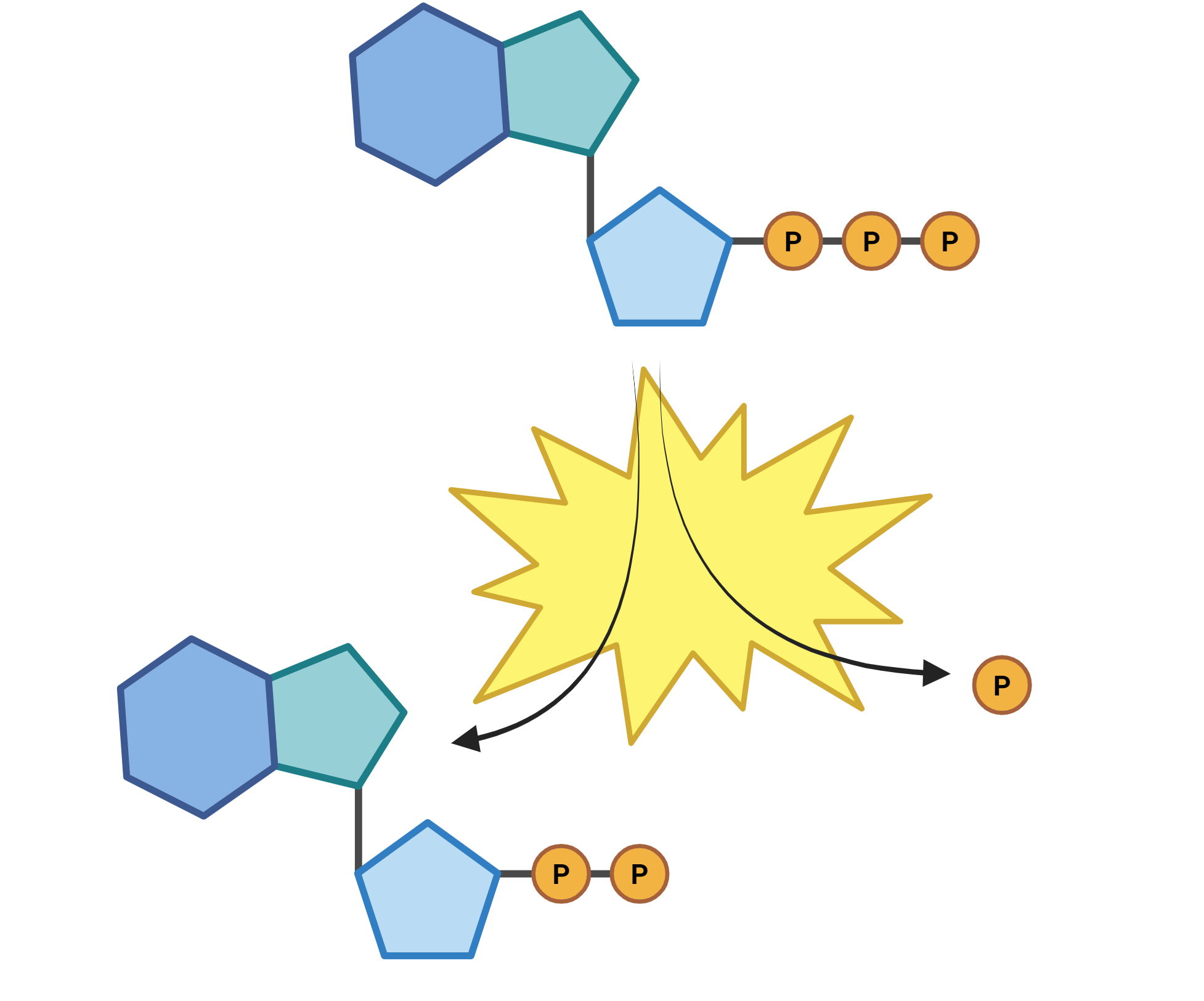
- To use the energy, the bond with the third phosphate group is broken, releasing its stored energy, which the cell can use to power cellular processes
- The ADP and lone phosphate group can then be refused and reused
Trophic Categories
Cells break down glucose to make ATP, and use the ATP as “energy currency”.
Autotrophs: Make their own glucose
- Phototroph: Uses energy from the sun to make glucose; photosynthesis
- Includes plants and select other organisms
- Chemiotroph: Uses energy from the breakdown of other chemicals to make glucose
Heterotrophs: Obtain glucose by eating other organisms
- Includes animals
Photosynthesis
Overview
- Equation:
- Photosynthesis takes $CO_2$ and $H_2O$, makes glucose, and releases $O_2$
- The $CO_2$ enters the plant, and the $O_2$ exits the plant, through stomata pores
- $H_2O$ is absorbed into the plant through its roots
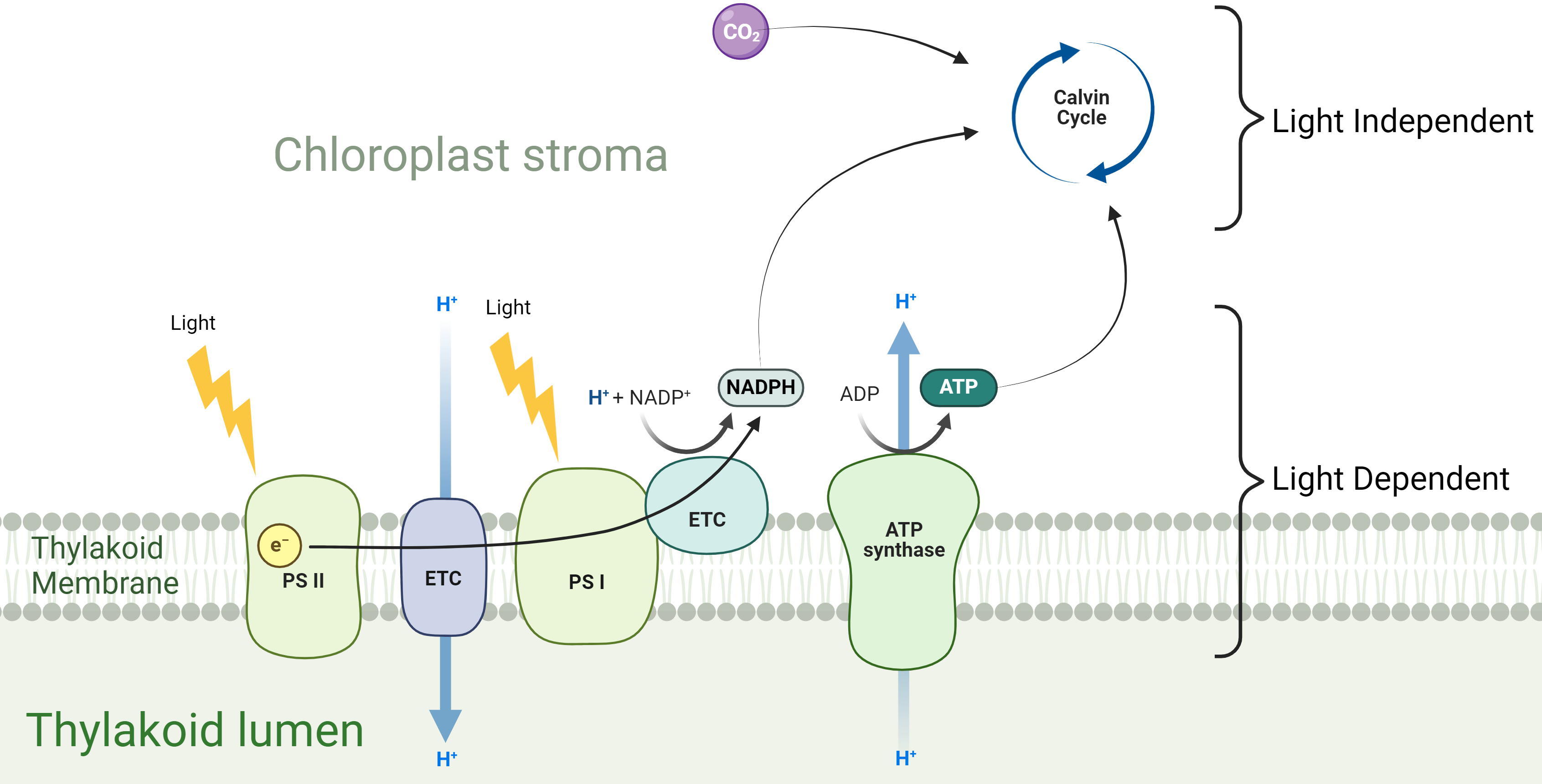
- Photosynthesis has two stages:
- Light dependent reaction: Stores energy from the sun in temporary energy-storing molecules
- Light independent reaction: Uses the energy in the temporary energy-storing molecules to make glucose from the hydrogen and $CO_2$
Chloroplasts
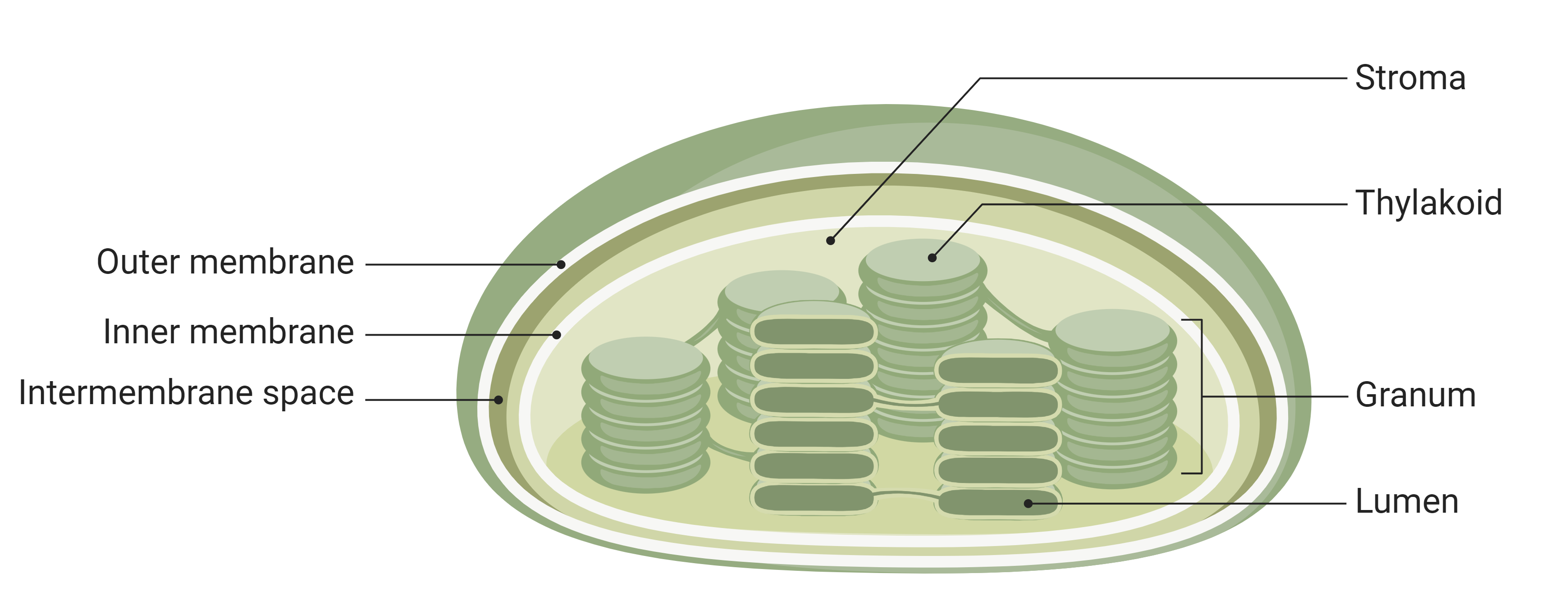
Chloroplast: Organelle in which photosynthesis takes place
- Contains a double outer membrane
- Thylakoids: Disc-like structure within choloroplasts
- Chlorophyll: Pigments within the thylakoid membrane; absorb sunlight
- Does not absorb green wavelength sunlight, instead reflects it, resulting in a green appearance
- Thylakoid lumen: Within the thylakoid membrane
- Chlorophyll: Pigments within the thylakoid membrane; absorb sunlight
- Granum (plural: grana): Stack of thylakoids
- Stroma: Space inside chloroplast not occupied by thylakoids, filled with fluid
- Also has its own DNA and ribosome
Light Dependent Reaction
- Photosystem II (PSII)
- Chlorophyll within PSII - a protein structure in the thylakoid membrane - absorb sunlight, exciting electrons
- The excited electrons move to the primary electron acceptor in the center of the photosystem
- The electrons go on to make ATP and join high-energy electron acceptors, which are used to make glucose
- $H_2O$ is broken to oxygen, $H^+$ protons, and electrons - photolysis; the electrons from $H_2O$ replace the electrons in the chlorophyll, the protons are used for the proton gradient to manufacture ATP and are eventually fused with the $CO_2$ to make glucose.
- Electron Transport Chain (ETC)
- The excited electron moves from the primary electron acceptor to the ETC - a series of proteins within the thylakoid membrane
- These proteins use the energy from the electron to pump protons from the stroma into the thylakoid lumen. This proton gradient will eventually be used to make ATP.
- The electron goes from the ETC to PSI.
- Photosystem I (PSI)
- PSI is another protein structure in the thylakoid membrane containing chlorophyl
- In PSI, the electron is re-energized
- The electron then moves to the second and final ETC
- ETC 2
- In the second ETC, NADP+ is reduced to NADPH, a high energy electron carrier
- The NADP+ accepts two high energy electrons, as well as a proton, turning it into NADPH
- NADPH advances to the light independent reaction and assists in the Calvin cycle. The hydrogen proton and electrons which are added to the CO2 come from the NADPH.
- ATP Synthase
- The proton gradient in the thylakoid lumen created by the first ETC is used to manufacture ATP
- Protons are diffused through ATP Synthase - a enzyme in the thylakoid membrane
- This diffusion powers the ATP synthase’s manufacturing of ATP
- Chemiosmosis: Using a chemical gradient’s diffusion to power a reaction
- Light Independent Reaction
- The NADPH from the ETC and the ATP from the ATP synthase advance to the light independent reaction, to manufacture glucose
Light Independent Reaction
Carbon Fixation: Converting nonorganic carbon - carbon without hydrogen, such as $CO_2$ - to organic carbon, such as glucose
Calvin Cycle: Light independent reaction; does not directly use light - instead, uses ATP and NADPH from the light dependent reaction to perform carbon fixation
- Takes place in the stroma
Process:
- $CO_2$ is combined with a five carbon molecule, RuBP, by the RuBisCO enzyme
- This splits into two 3-PGA molecules molecules - each with three carbons
- ATP and NADPH turn each 3-PGA into G3P
- Most G3Ps remain, and are turned back into RuBP by ATP to be cycled again
- Some G3Ps then leave the chloroplast, and, in the cell cytoplasm, are made into glucose.
C3, C4, CAM Plants
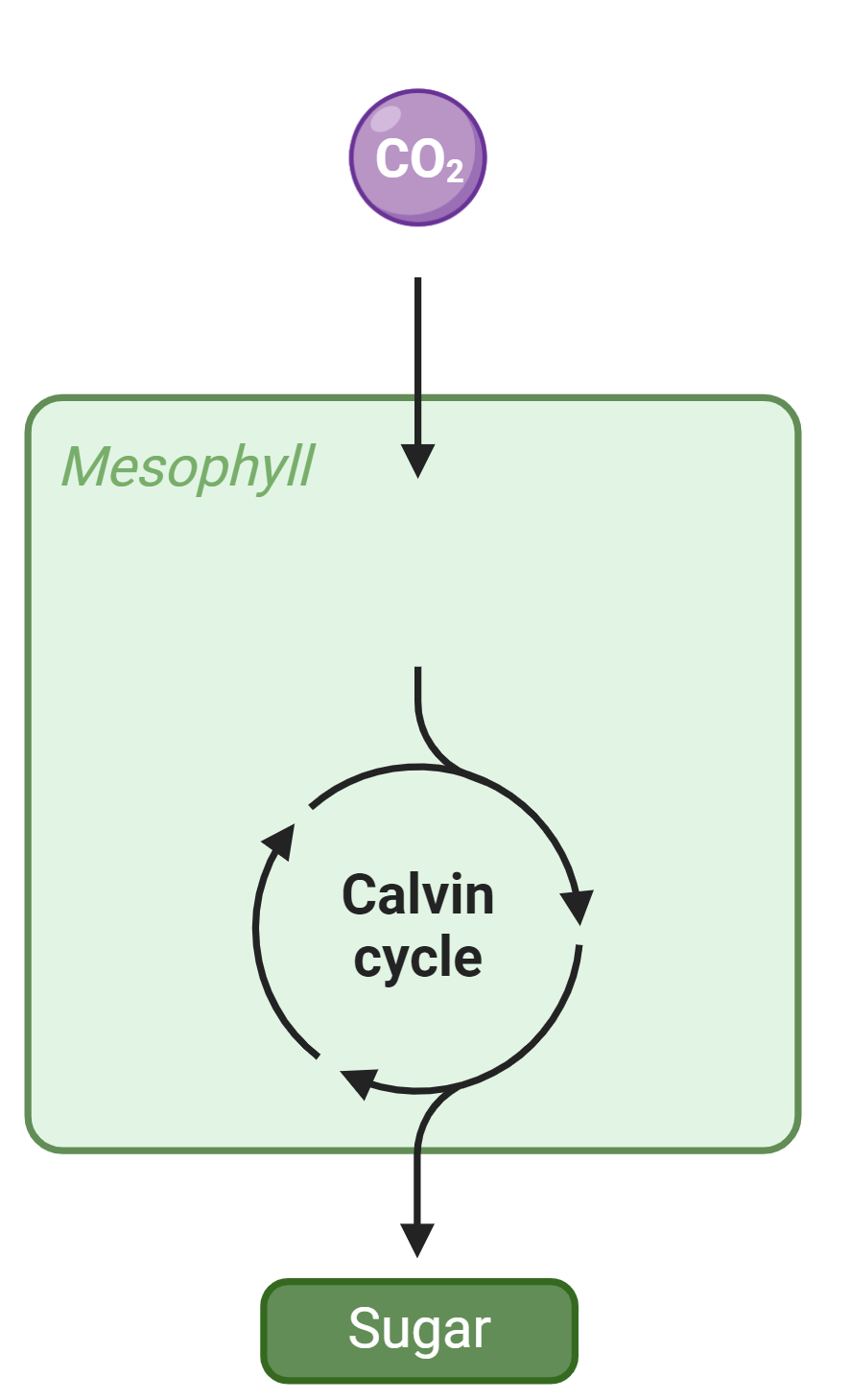
C3: Most plants are C3 plants, meaning, they use the C3 carbon fixation path.
- The C3 path is the path described above, in which the plant captures $CO_2$, and, during the Calvin cycle, directly performs carbon fixation, bonding the carbon with the RuBP and making the three-carbon 3-PGA
- However, this has a potential issue:
- Photorespiration: If there is not enough $CO_2$ in the area where the Calvin Cycle is to take place, and there is a lot of oxygen, the Rubisco may bond oxygen, instead of $CO_2$, with the RuBP. This results in a net loss of energy and carbon and is highly inefficient.
- In high temperature environments, plants close their stomata to avoid losing $H_2O$ to evaporation. However, this also blocks $CO_2$ from entering the cell, and $O_2$ from exiting the cell, which can lead to an oxygen build up, resulting in photorespiration.
- Some plants have techniques to avoid this issue:
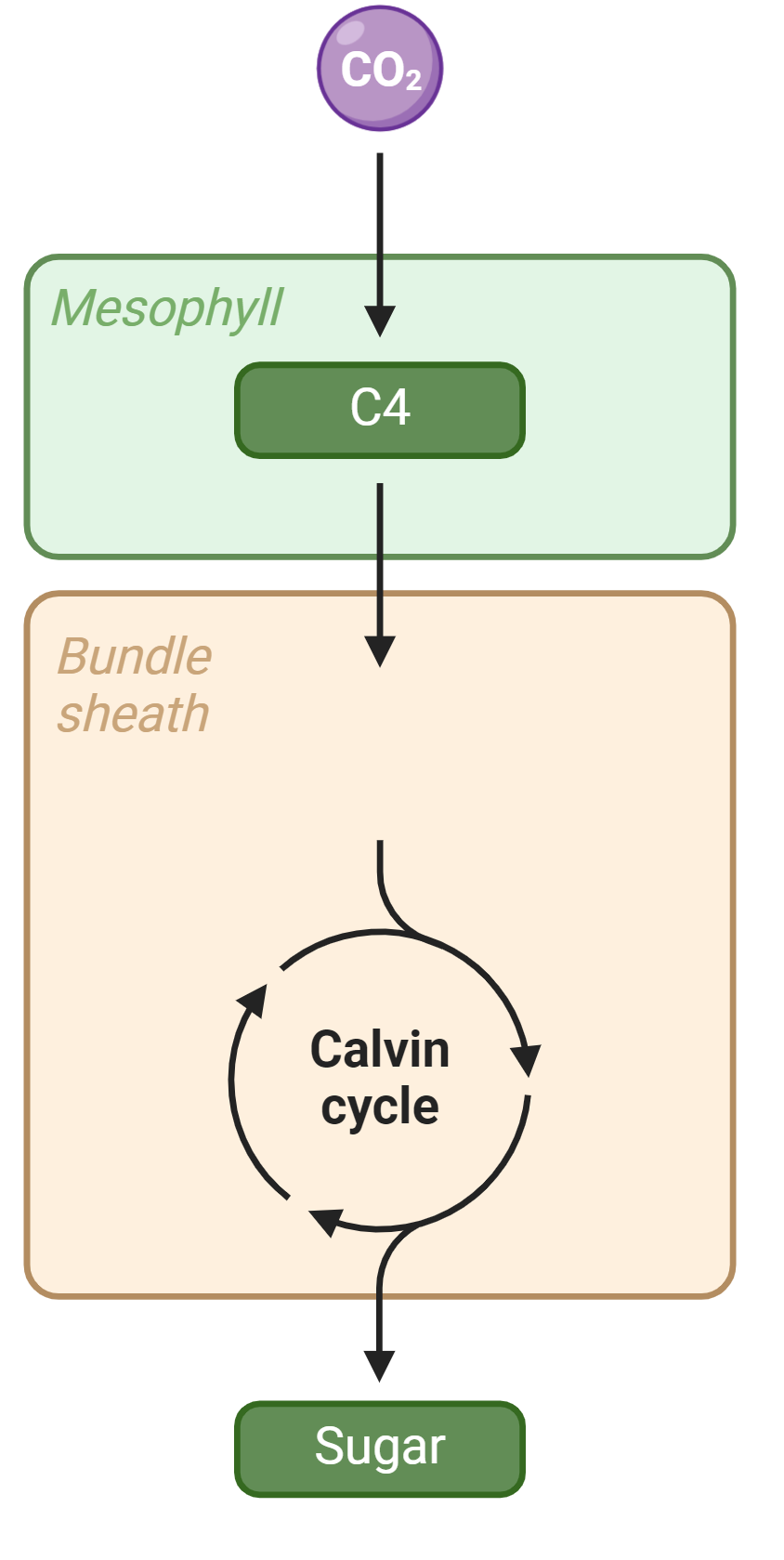
C4 Plants: C4 plants use the C4 path
- In the C4 path, the plant captures carbon in close-to-surface mesophyll cells and forms 4-carbon molecules.
- The packed 4-carbon molecule then goes to inner-cell low-oxygen bundle-sheath cells, where the Calvin cycle takes place.
- This ensures a high carbon concentration in the bundle-sheath cell and avoids photorespiration.
- Includes: Maize, sugarcane, grass
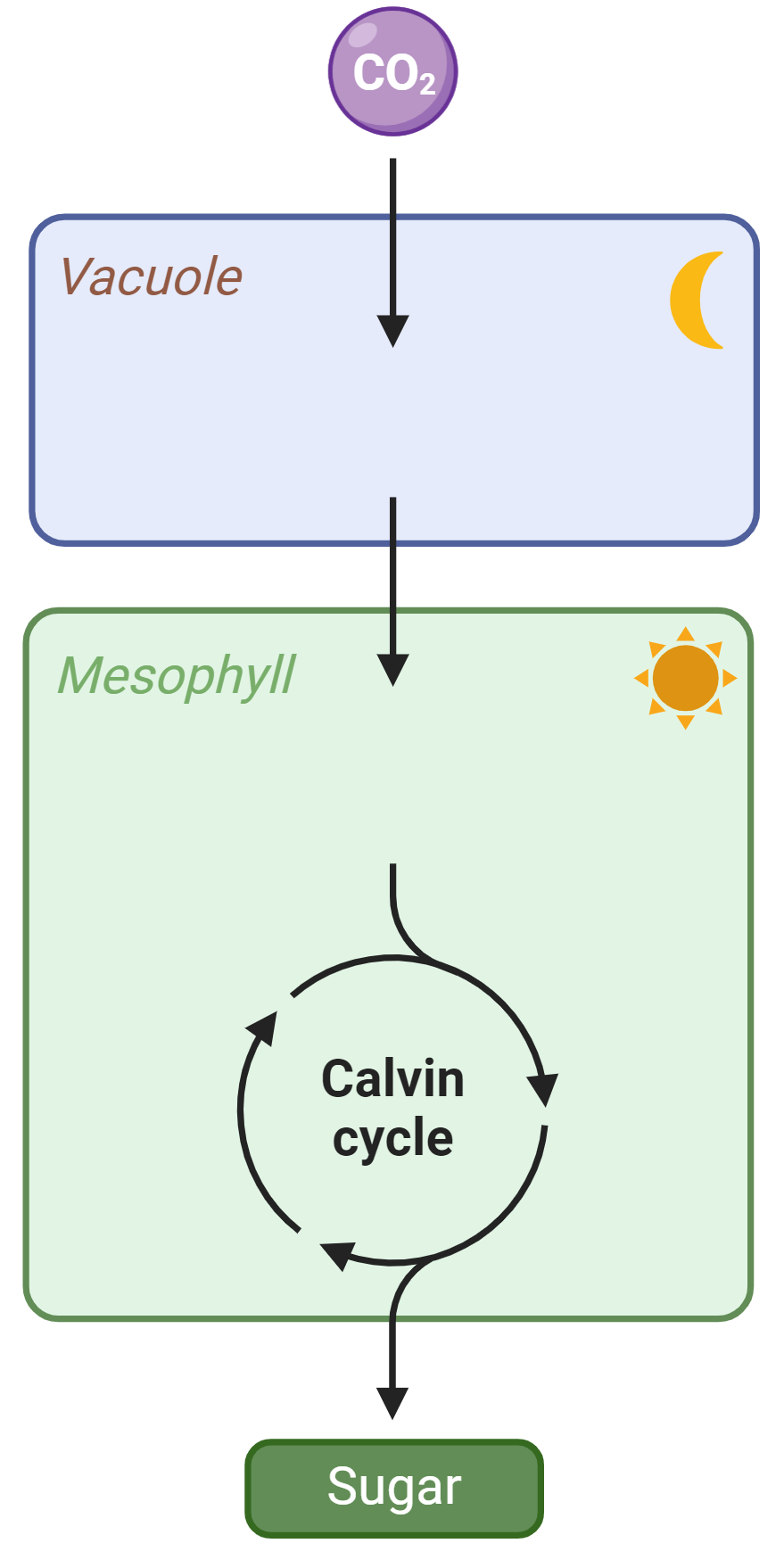
CAM Plants:
- CAM plants capture $CO_2$ at night and store the carbon in vacuoles.
- Then, during the day, when there is sunlight and the light dependent reaction takes place, it releases the carbon.
- This ensures an adequate supply of carbon during the day when the photosynthesis occurs even though its stomata is closed.
- Includes: Pineapple, cactus, succulents
Cellular Respiration
Overview
- Equation:
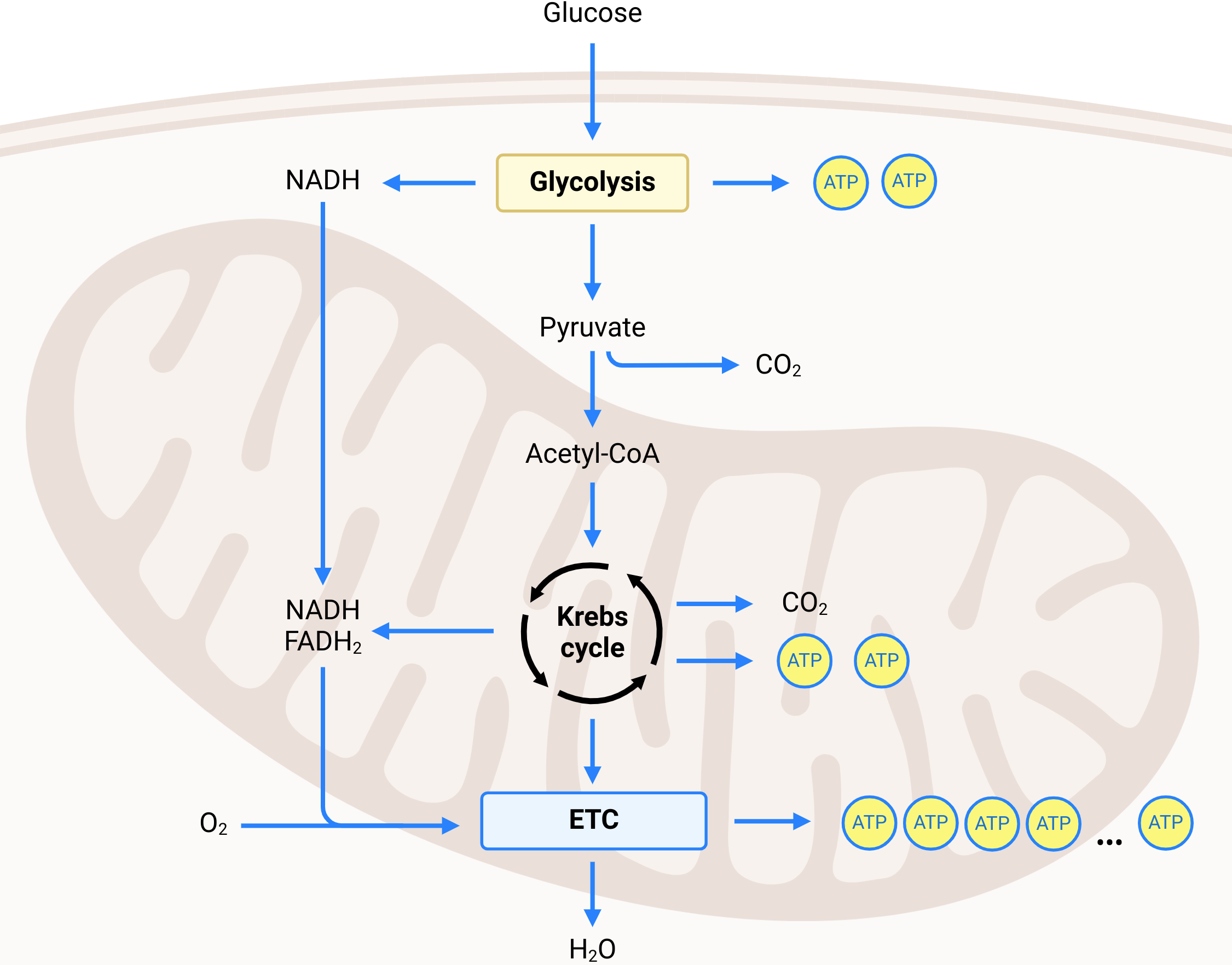
- Cellular respiration takes glucose and oxygen; breaks down the glucose into $CO_2$ and hydrogen, releases the $CO_2$, uses the oxygen to collect the hydrogen and release $H_2O$, and uses the energy released from the glucose to create ATP.
- Cellular respiration takes place over many steps:
- In the first few steps, it breaks down the glucose, creating a small amount of ATP, as well as several high energy electrons acceptors which it later uses to further break down the glucose.
- As it breaks down the glucose, it uses the released energy to create a proton gradient.
- Finally, the proton gradient diffuses through ATP synthase, creating a large amount of ATP. The bulk of the produced ATP is from the ATP synthase.
- The ATP synthesis in the earlier steps occurs directly, without ATP synthase - substrate-level phosphorylation
Mitochondria
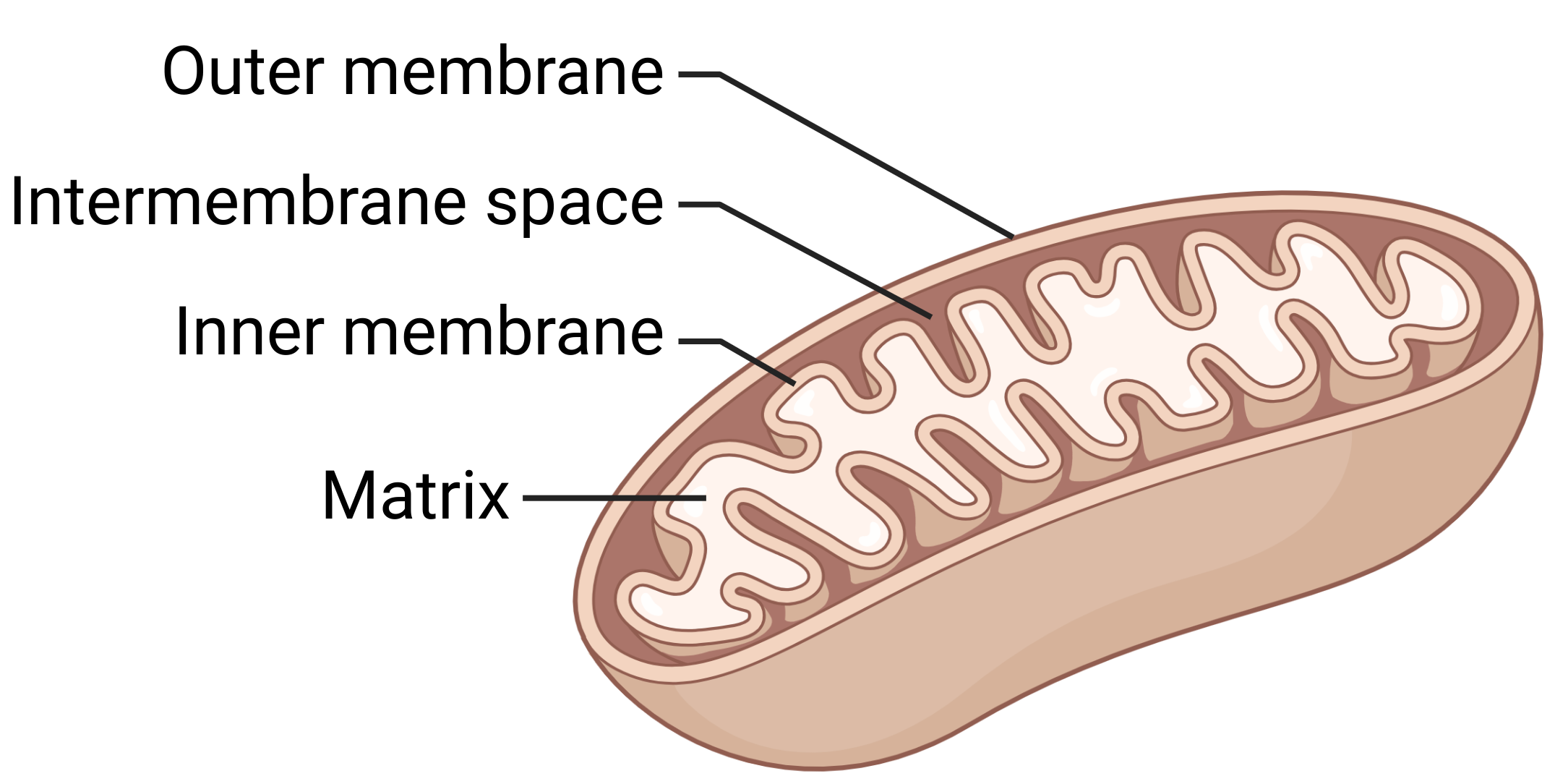
Mitochondria: Organelle in which most of cellular respiration takes place
- Contains an outer membrane
- Contains an inner membrane with cristae - folds
- The area between the two membranes is the intermembrane space.
- The area inside the inner membrane is the mitochondrial matrix.
Glycolysis
Glycolysis: First step of cellular respiration
- Takes place in the cytoplasm
- Glucose is split into two three-carbon molecules - pyruvates
- Consumes 2 ATP to split the glucose, produces 4 ATP with the energy released, netting 2 ATP
- Produces two NADH high-energy electron carriers
- NAD+ accepts two electrons and a $H^+$ proton, creating NADH
- The NADH are later used in the ETC
- The high-energy electron carrier temporarily stores the energy released in glycolysis, later passing on the energy in the ETC
Pyruvate Oxidation
Pyruvate Oxidation: Occurs between glycolysis and the Krebs cycle
- Takes place in the mitochondrial matrix
- Oxidizes pyruvates to acetyl, a two-carbon molecule
- Releases a $CO_2$ molecule
- Bonds acetyl with coenzyme-A, creating acetyl-CoA, which is then used in the Krebs cycle
- Creates NADH - one per pyruvate; two per glucose
- May produce ATP
Krebs / Citric Acid Cycle
Krebs / Citric Acid Cycle: Completes the glucose breakdown
- Takes place in the mitochondrial matrix
- Takes acetyl-CoA
- Occurs once for each acetyl-CoA; twice in total for each glucose
- Breaks down the acetyl-CoA, releasing the two remaining carbons as two molecules of $CO_2$
- Produces some $H_2O$
- Creates ATP, NADH and FADH2
- ATP - one per cycle; two per glucose
- NADH - three per cycle; six per glucose
- FADH2 - one per cycle; two per glucose
- FADH2: High energy electron acceptor
- FAD accepts two electrons and two hydrogen protons, creating FADH2
Electron Transport Chain (ETC)
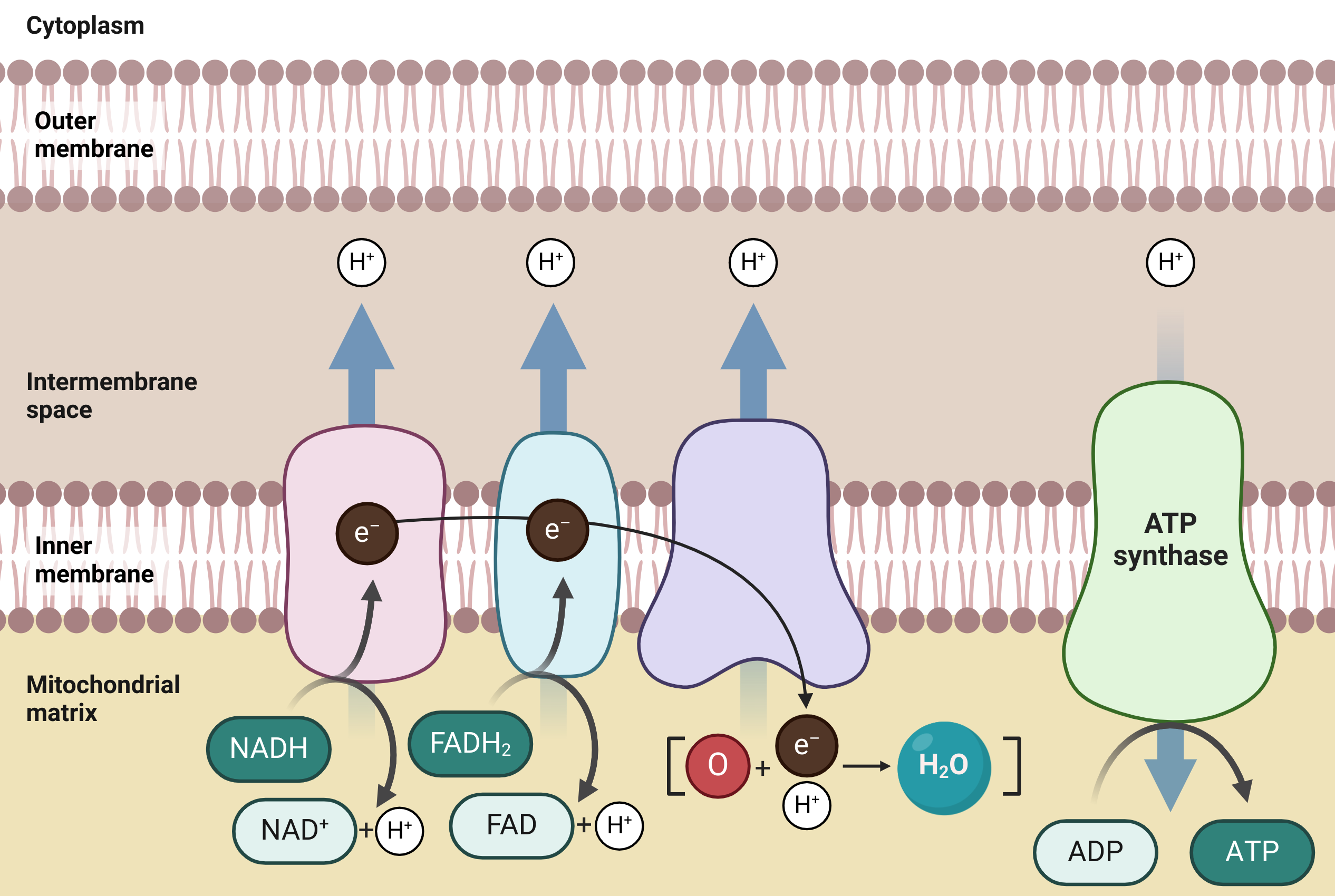
Electron Transport Chain: Uses high-energy electron carriers to make a proton gradient
- The ETC consists of protein channels in the inner membrane
- The high-energy electron carrier NADH and FADH2s that were created during glycolysis, pyruvate oxidation and the Krebs cycle move through the ETC proteins
- The proteins use the electron carriers’ energy to pump protons from the inner membrane matrix into the intermembrane space, creating a proton gradient
ATP Synthase
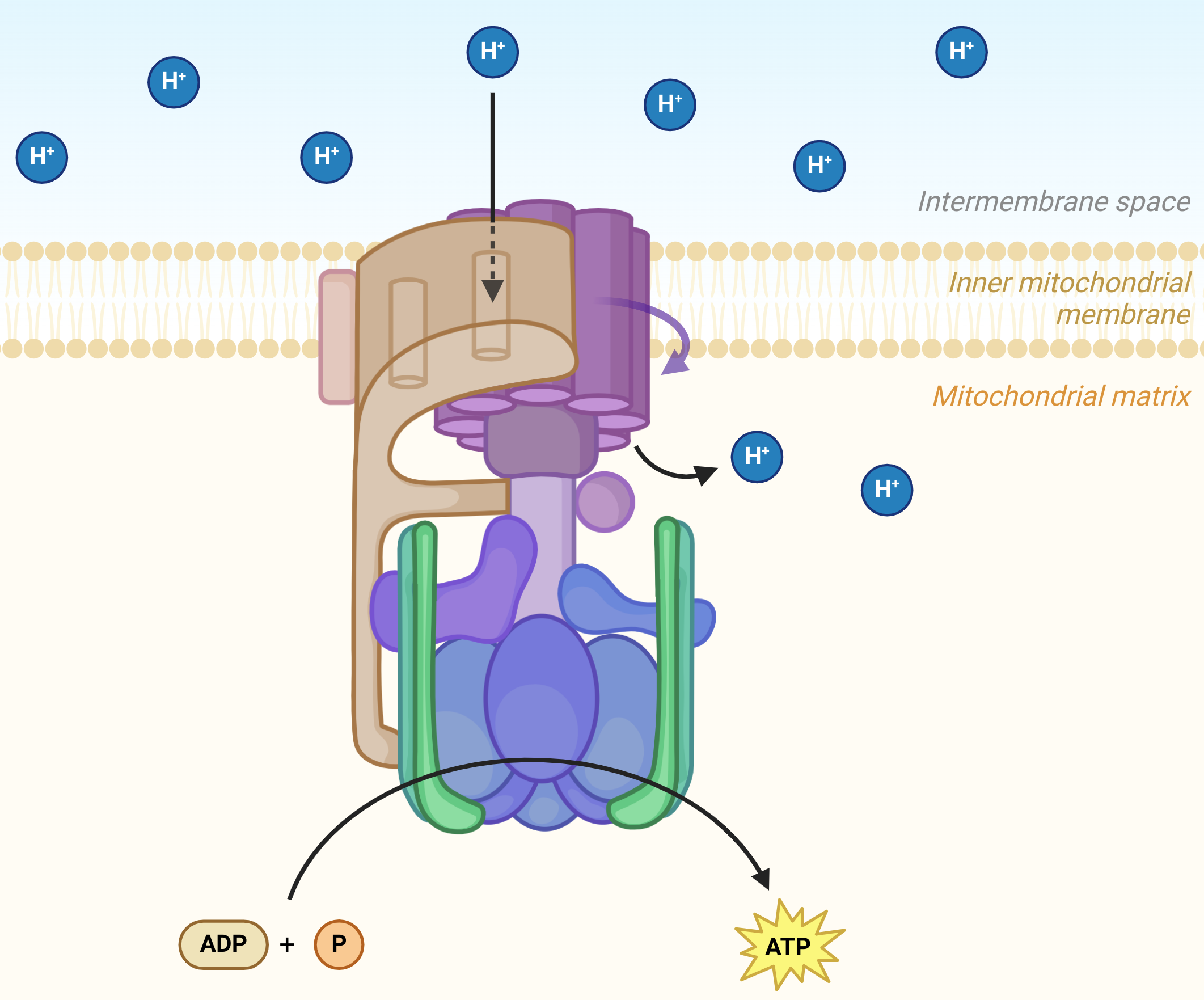
ATP Synthase: Final ATP manufacturing step
- Finally, the proton gradient causes protons to diffuse through ATP synthase - an enzyme in the inner membrane
- Powered by the proton diffusion, the ATP synthase synthesizes ATP
- This ATP synthase is oxidative phosphorylation: the adding of a phosphate powered by electron that were released from an oxidation reaction
- In general, 30-38 ATP are manufactured per glucose in ATP synthase
- This is in addition to the 2 ATP from glycolysis and 2 ATP from the Krebs cycle and possible ATP from the pyruvate oxidation
Final Electron Acceptor
Having given its energy to the ETC, the electrons are finally accepted by oxygen, which bonds with hydrogen and is released as $H_2O$
The oxygen is called the final electron acceptor
Anaerobic Respiration
Aerobic Respiration: Cellular respiration in the presence of oxygen
- The above cellular respiratory process describes the ideal cellular respiration which occurs in the presence of oxygen
- The presence of oxygen as the final electron acceptor allows the glucose to be completely broken down
Anaerobic Respiration: Cellular respiration without oxygen
- Without oxygen, the cell cannot fully break down the glucose
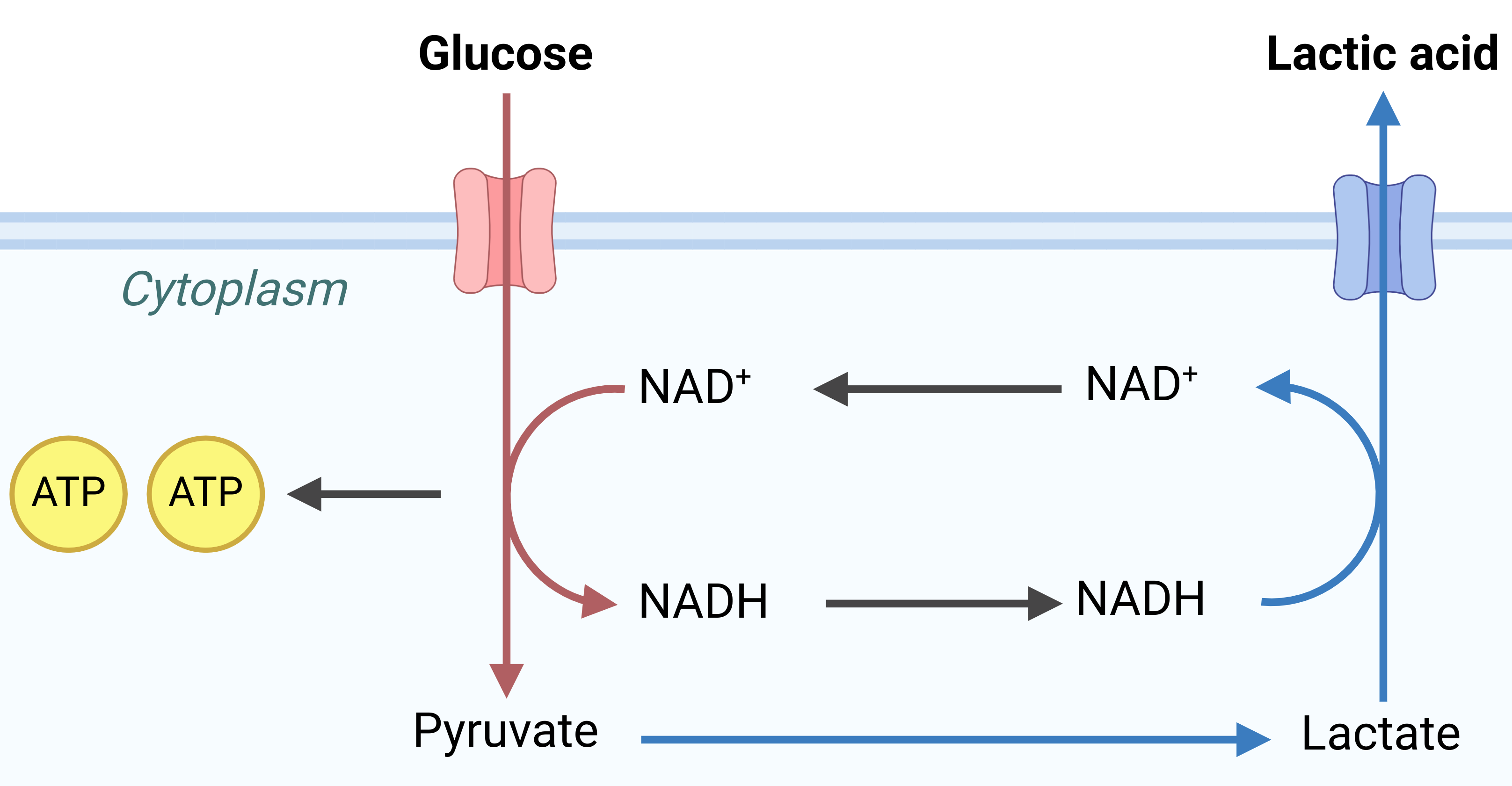
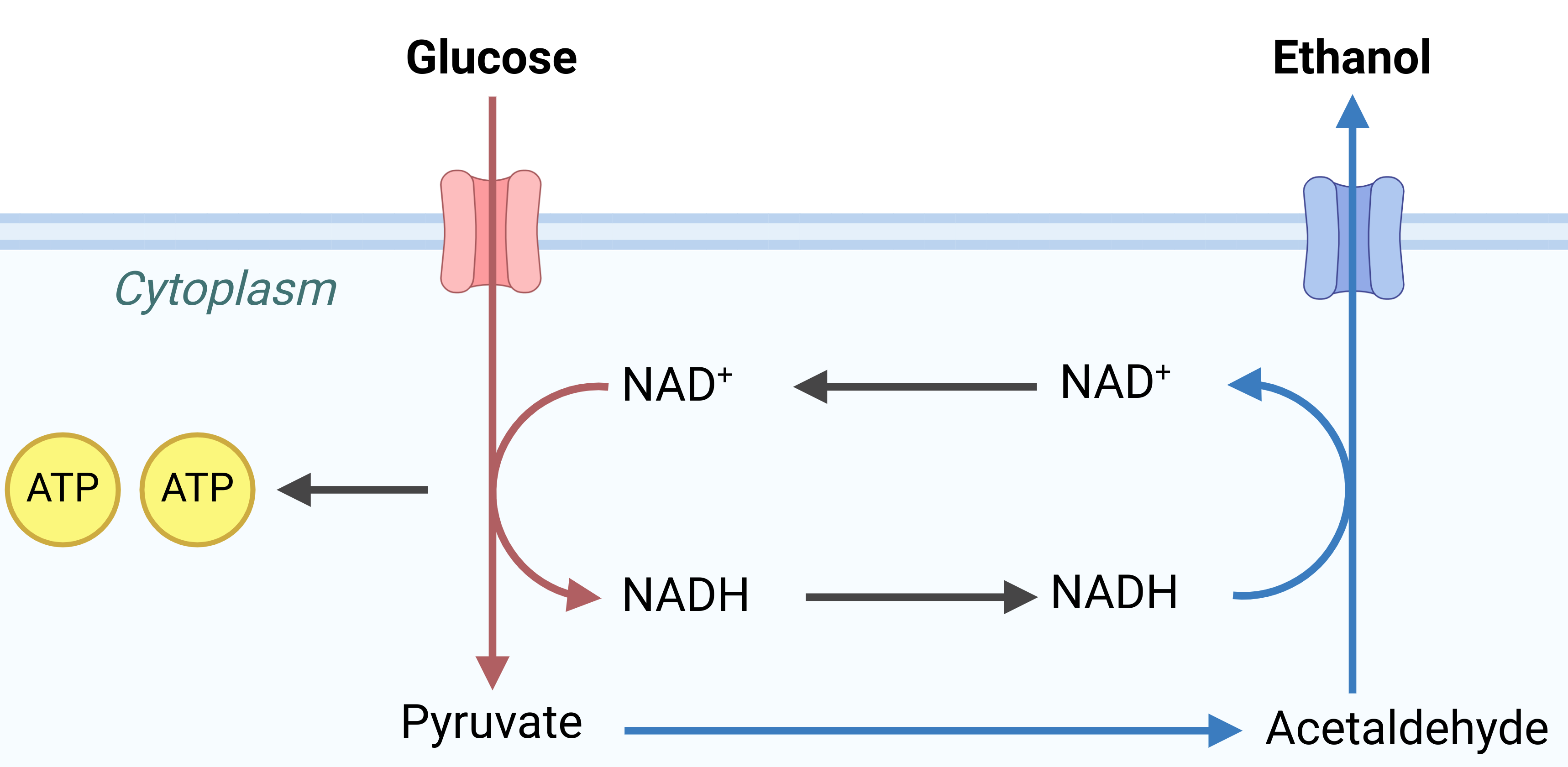
- The only step of cellular respiration that can be done without oxygen is glycolysis
- This nets 2 ATP per glucose
- It also reduces two NAD+s to two NADHs, and produces two pyruvates.
- Instead of advancing to the Krebs cycle and the ETC, the pyruvates undergo fermentation.
- Fermentation is necessary to oxidize NADH back to NAD+, which allows glycolysis to repeat with another glucose molecule
- Animals perform lactic acid fermentation, converting pyruvates to lactic acid.
- Equation:
- Plants and yeast perform alcoholic fermentation, converting pyruvates to ethanol and carbon dioxide.
- Equation:
- The fermentation products are removed from the cell.
- Lactic acid is sent to the liver and may be turned back into pyruvates
- In muscle cells, lactic acid accumulation can cause muscle fatigue
Schematics
- ATP
-
ATP
-
ADP
-
ATP storing energy
-
ATP releasing energy
-
- Photosynthesis
-
Overview
-
Chloroplast
-
Light dependent, independent
-
C3
-
C4
-
CAM
-
- Cellular Respiration
-
Mitochondria
-
Cellular Respiration
-
ETC, ATP Synthase
-
ATP Synthase
-
Lactic acid fermentation
-
Alcoholic fermentation
-